
The Day of Arafah
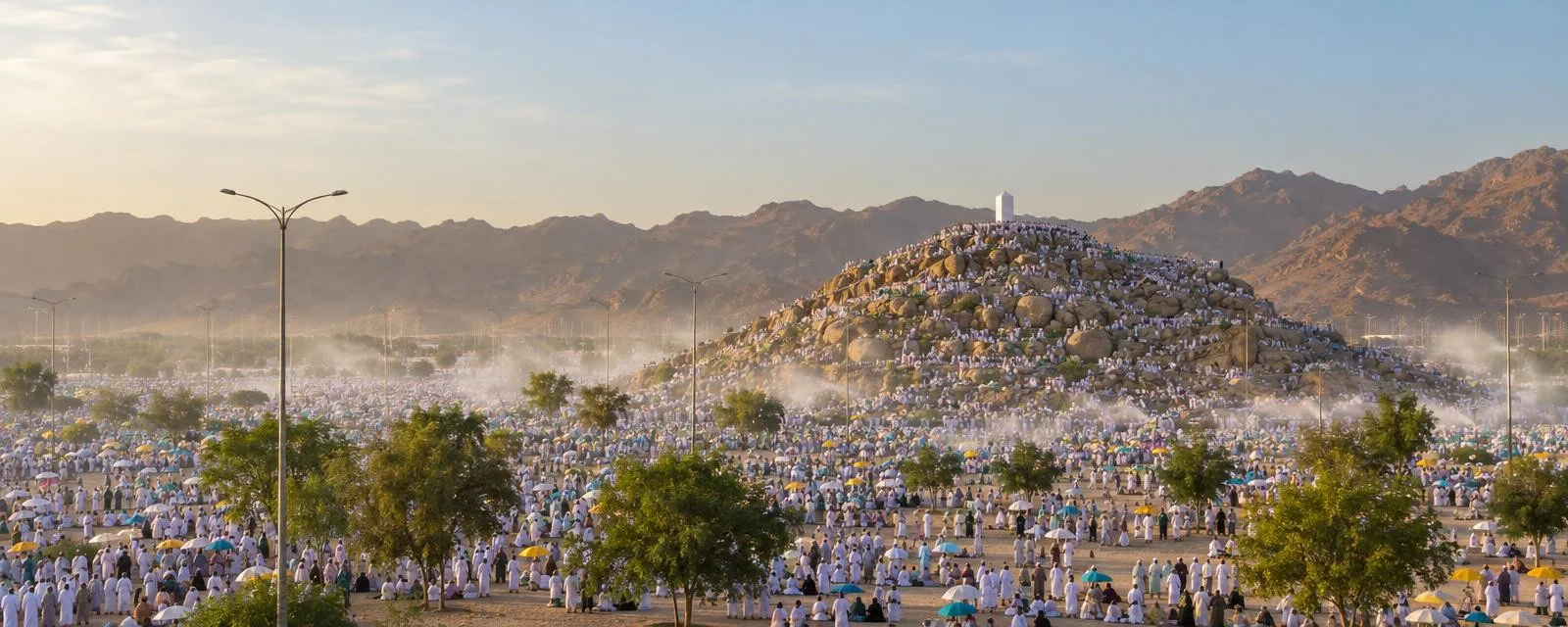
The Day of Arafah is the 9th day of Dhul Hijjah, the day before Eid al-Adha, when the pilgrims stand on the plain of Arafat. In 2027 it is expected on Saturday 15 May (Saudi Arabia's Umm al-Qura calendar).
Project Arafah ·
When is the Day of Arafah?
The Day of Arafah is the 9th day of Dhul Hijjah, one of the four sacred months of the Islamic year. It is the day before Eid al-Adha, the festival of the Eid sacrifice. The place where the pilgrims stand on that day is Arafat, which Arabic also calls Arafah.
Day of Arafah 2027, and the dates for 2026 to 2030
In 1447 AH, Saudi Arabia announced the standing at Arafat for Tuesday 26 May 2026, and Eid al-Adha for Wednesday 27 May 2026. For the next four years, Saudi Arabia's official Umm al-Qura calendar gives these expected dates.
| Year | Date | Status |
|---|---|---|
| 1447 AH | Tuesday 26 May 2026 | Announced by the Saudi Supreme Court (SPA, 17 May 2026); Eid al-Adha Wednesday 27 May 2026 |
| 1448 AH | Saturday 15 May 2027 | Expected (Umm al-Qura) |
| 1449 AH | Thursday 4 May 2028 | Expected (Umm al-Qura) |
| 1450 AH | Monday 23 April 2029 | Expected (Umm al-Qura) |
| 1451 AH | Friday 12 April 2030 | Expected (Umm al-Qura) |
Future dates are the expected dates in Saudi Arabia's official Umm al-Qura calendar. The Saudi Supreme Court fixes the actual day after the crescent is sighted, and it can differ by a day. Other countries may also observe 9 Dhul Hijjah a day later.
The Gregorian date moves about 11 days earlier each year. From one year to the next the shift is 10, 11 or 12 days.
A note for 2027. The expected date, 15 May 2027, is a Saturday. The four Sunni schools allow fasting the Day of Arafah on a Saturday. Al-Albani held otherwise. Both positions are set out under Fasting on a Friday or a Saturday.
How the date is set
Umm al-Qura is the official Hijri calendar of Saudi Arabia. It was first issued in 1346 AH in Makkah. Since 1400 AH a committee of Sharia and astronomy experts has supervised it, and since 1420 AH it has been calculated for the coordinates of the Kaaba. Its official website is run by KACST, a Saudi government body.
The calendar's official site states its current rule: "a new month begins when the crescent is born and the moon sets after sunset in Makkah".
The calendar gives the expected date. The real date each year is fixed by the Saudi Supreme Court. The court asks Muslims to look for the crescent on the evening of the 29th of Dhul Qa'dah and to report a sighting, by naked eye or binoculars, to the nearest court.
If the crescent is sighted, the next day is 1 Dhul Hijjah. If no sighting is established, the court completes Dhul Qa'dah as 30 days. It cites The Prophet's ﷺ words in al-Bukhari's wording (Sahih al-Bukhari 1907) that tell Muslims to complete thirty days when the crescent is hidden. It then announces 1 Dhul Hijjah, the day of the standing at Arafat and the day of Eid.
The court's "29th" can differ from the calendar's. In 1447 AH the court called for the sighting on Sunday 17 May 2026. By Umm al-Qura that evening was the 30th of Dhul Qa'dah; by the court's decision it was the 29th.
The observed day can also differ by one day from the calendar. In 1436 AH, Umm al-Qura gave Tuesday 22 September 2015, but the Day of Arafah was observed on Wednesday 23 September 2015 (Euronews).
Why your country's date can differ
Other countries can observe 9 Dhul Hijjah one day later than Saudi Arabia. In 1446 AH (2025), Saudi Arabia, the UAE, Oman and Qatar kept the Day of Arafah on 5 June and Eid on 6 June. Press reports gave Saturday 7 June for Eid in Brunei, Malaysia, India, Bangladesh, Pakistan, Morocco and Mauritania.
Saudi date or local date: which day should I fast?
When your country's 9th of Dhul Hijjah falls on a different day from Saudi Arabia's, scholars differ on which day to fast. There are two views.
View 1: fast the 9th of your own country's sighting. Ibn Uthaymin held that the crescent differs from one horizon to another, so each country fasts its own 9th. He called this "the preponderant view" (Majmu' Fatawa wa Rasa'il 20/47–48). He told Saudi embassy staff abroad to fast with the country they live in, "and likewise for the Day of Arafah, follow the country you are in" (19/39–41). islamqa.info also calls this "the preponderant view" (answer 140011).
View 2: the Day of Arafah is the day the pilgrims stand at Arafat. Saudi Arabia's Permanent Committee answered a questioner whose radio said the Day of Arafah was "tomorrow", while it was the 8th in his own country. The committee said: "The Day of Arafah is the day on which the people stand at Arafah, and fasting it is prescribed for whoever is not on Hajj. If you want to fast, fast this day. If you fast a day before it, there is no harm …" (fatwa 4052, signed by Abd Allah ibn Ghudayyan and Abd al-Aziz ibn Baz; Fatawa al-Lajna al-Da'ima, first collection, 10/393–394; our translation).
Egypt's Dar al-Ifta (Mufti Ali Gomaa, fatwa 3951, 2004) said that the reference for the days of Arafah and Eid is the sighting of the moon in Makkah, and that no Muslim country may set them by a local sighting that conflicts with Saudi Arabia's. That fatwa speaks to states and to the dates themselves. It does not discuss an individual's voluntary fast separately.
Background. In 1986 the OIC International Islamic Fiqh Academy resolved that a sighting established in one country binds Muslims and that differences of horizon are not taken into account. Its resolution is about the lunar months in general and does not mention Arafah. The Fiqh Council of North America sets Eid al-Adha by the Makkah announcement of the Day of Arafah. An article on its site by Dr. Zulfiqar Ali Shah says that Muslims who could know the real day of the standing preferred to fast on that day.
What we suggest. Follow the Muslim authority or community where you live. Ibn Uthaymin, who held View 1, also advised Muslims in non-Muslim lands to agree on one thing and follow the head of their Muslim community, "because the matter is broad" (19/43).
When does the fast start and end where I live?
The fast of Arafah begins at true dawn (Fajr) and ends at sunset (Maghrib) where you are. Sunni scholars report consensus on this: Ibn Abd al-Barr for the whole day from dawn to sunset, and Ibn Hazm and al-Nawawi for its end at sunset, as cited by the Dorar encyclopedia.
Fajr and Maghrib where you live
Find your town on our prayer times pages. The "Fast today" tile shows Fajr and Maghrib for the calculation method you choose.
Very long days, and travel by air. Where the day lasts eighteen hours or more, Egypt's Dar al-Ifta suggests fasting as many hours as Makkah, starting from local dawn (fatwa 231, Ali Gomaa, 2011). Others, among them Ibn Baz and Ibn Uthaymin, hold that a long day that still has a sunset is fasted from dawn to sunset; only where day and night do not alternate within 24 hours are times estimated from the nearest place where they do (as the Dorar encyclopedia summarises). On a plane, the fast ends when the sun sets where the plane is (Dar al-Ifta fatwa 1720, Ali Gomaa, 2009). Follow the timetable of your local Muslim authority.
The eve of the Day of Arafah. In Islamic law and usage a night comes before its day. So the night before the 9th, which begins at sunset on the 8th, is "the night of Arafah", and the fast itself starts at dawn on the 9th. Some scholars used "the night of Arafah" for the night after the 9th; Ibn al-Qayyim records that view. That is why this page says "the eve of the Day of Arafah" for the night before the 9th.
Is the Day of Arafah a holiday?
In Saudi Arabia it is. Private-sector workers get a four-day Eid al-Adha holiday that starts on the Day of Arafah. For government staff, the Eid al-Adha holiday runs from the 5th to the end of the 15th of Dhul Hijjah, so the Day of Arafah falls inside it.
What "Arafah" means
"Arafat", or "the plain of Arafat", names the place. "The Day of Arafah" names the day. Arabic also calls the place Arafah, so both spellings are used.
The Dorar encyclopedia, citing the classical dictionaries, records two views. In one, both words name the same place. In the other, only "Arafat" names the mountain or the place, and "Arafah" means the day of standing there.
"Arafat" has a plural form but names one place. Al-Tabari called it "a name for one thing, given a plural form".
Why is it called Arafah?
Scholars give several explanations. The best known is that the angel Jibril showed Ibrahim the rites of Hajj, place by place, and Ibrahim said, "I know" ('araftu); in one report Jibril asks him, "Do you know?" (below).
Al-Tabari records Ibrahim's words "I know" in reports from Companions and their students: from Ali ibn Abi Talib (may Allah be pleased with him) and Ibn Abbas (may Allah be pleased with them both), and from the Successors Nu'aym ibn Abi Hind and Ata. These are early reports, not sayings of The Prophet ﷺ. We found no formal grading of their chains, and Allah knows best.
One naming report does carry grades. In Musnad Ahmad (no. 2707), Ibn Abbas (may Allah be pleased with them both) says in his own words that, after Satan met Ibrahim at the Jamarat in Mina, Jibril took him to Arafah and asked him, "Do you know?", "and from there it was named Arafah". Ahmad Shakir graded its chain sahih. Shu'ayb al-Arna'ut said its men are trustworthy except Abu Asim al-Ghanawi, and that most of it is supported by other routes.
Other explanations are reported too:
- Ibrahim recognised the place from a description given to him (al-Suddi, in al-Tabari).
- Adam and Hawwa met there and recognised each other. This is a statement of al-Dahhak, quoted by al-Qurtubi without a chain. It is a report, not an established fact.
- People come to know one another there (al-Qurtubi); al-Raghib adds that worshippers make themselves known to Allah there through worship and dua.
- The name comes from 'arf, fragrance: a place made fragrant (reported by al-Qurtubi with "it is said").
- The name was simply given, like other place names (Ibn Atiyya, quoted by al-Qurtubi).
Other names and spellings
Ibn Kathir gives other names for the place: al-Mash'ar al-Halal, al-Mash'ar al-Aqsa and Ilal.
The day before Arafah is Yawm al-Tarwiya, the 8th. Ibn Qudama explains that pilgrims took water on that day for the Day of Arafah. The day after is Yawm al-Nahr, the 10th, the Day of Sacrifice.
Readers write the day and the plain in many ways: Arafah, Arafat, Arafa, 'Arafāt, Yawm Arafah, Youm-e-Arafat (in South Asia) and Hari Arafah (in Malay and Indonesian).
The small hill in the middle of the plain has its own names: Jabal al-Rahmah (also written Jabal ar-Rahmah), the Mount of Mercy, and "Mount Arafat", which Saudipedia gives as the hill's popular name. "Mount Arafat" is the hill, not the whole plain and not the day.
Arafah in the Quran
Arafat is named only once in the Quran, in al-Baqarah 2:198. The word "Arafah" does not occur in the Quran.
2:198
لَیْسَ عَلَیْكُمْ جُنَاحٌ اَنْ تَبْتَغُوْا فَضْلًا مِّنْ رَّبِّكُمْ ؕ فَاِذَاۤ اَفَضْتُمْ مِّنْ عَرَفٰتٍ فَاذْكُرُوا اللّٰهَ عِنْدَ الْمَشْعَرِ الْحَرَامِ ۪ وَاذْكُرُوْهُ كَمَا هَدٰىكُمْ ۚ وَاِنْ كُنْتُمْ مِّنْ قَبْلِهٖ لَمِنَ الضَّآلِّیْنَ ۟
Saheeh International
There is no blame upon you for seeking bounty from your Lord [during ḥajj]. But when you depart from ʿArafāt, remember Allāh at al-Mashʿar al-Ḥarām. And remember Him, as He has guided you, for indeed, you were before that among those astray.
In this verse Allah tells the pilgrims to remember Him at al-Mash'ar al-Haram when they pour down from Arafat. Al-Tabari explains "remember Allah" here as prayer and dua. The jurists cite this verse as a basis for the standing at Arafat.
The next verse tells the pilgrims to depart from where the people depart, and to ask Allah's forgiveness.
2:199
ثُمَّ اَفِیْضُوْا مِنْ حَیْثُ اَفَاضَ النَّاسُ وَاسْتَغْفِرُوا اللّٰهَ ؕ اِنَّ اللّٰهَ غَفُوْرٌ رَّحِیْمٌ ۟
Saheeh International
Then depart from the place from where [all] the people depart and ask forgiveness of Allāh. Indeed, Allāh is Forgiving and Merciful.
Aisha, Mother of the Believers (may Allah be pleased with her), explains in Sahih al-Bukhari that this verse came down about the Quraysh and those who followed their religion, called al-Hums. They stopped at Muzdalifah while the other Arabs stood at Arafat. When Islam came, Allah commanded His Prophet ﷺ to go to Arafat, stand there and then depart from it.
Sahih al-Bukhari 4520Book 65, Hadith 45
The Quraish people and those who embraced their religion, used to stay at Muzdalifa and used to call themselves Al-Hums, while the rest of the Arabs used to stay at `Arafat. When Islam came, Allah ordered His Prophet to go to `Arafat and stay at it, and then pass on from there, and that is what is meant by the Statement of Allah:--"Then depart from the place whence all the people depart......" (2.199)
Ibn Kathir names this as the view of Ibn Abbas (may Allah be pleased with them both), Mujahid, Ata, Qatada and al-Suddi. Al-Tabari chose it and reported consensus on it. The same account is in Sahih al-Bukhari 1665 and Sahih Muslim 1219a.
In this verse, asking forgiveness is linked to the departure from Arafat. For people who are not on Hajj, the verse supports the general merit of seeking forgiveness after worship.
The verse revealed on the Day of Arafah (5:3)
Umar ibn al-Khattab (may Allah be pleased with him) reported that a verse of al-Ma'idah, 5:3, came down while The Prophet ﷺ was standing at Arafah on a Friday, during his Farewell Hajj.
5:3
حُرِّمَتْ عَلَیْكُمُ الْمَیْتَةُ وَالدَّمُ وَلَحْمُ الْخِنْزِیْرِ وَمَاۤ اُهِلَّ لِغَیْرِ اللّٰهِ بِهٖ وَالْمُنْخَنِقَةُ وَالْمَوْقُوْذَةُ وَالْمُتَرَدِّیَةُ وَالنَّطِیْحَةُ وَمَاۤ اَكَلَ السَّبُعُ اِلَّا مَا ذَكَّیْتُمْ ۫ وَمَا ذُبِحَ عَلَی النُّصُبِ وَاَنْ تَسْتَقْسِمُوْا بِالْاَزْلَامِ ؕ ذٰلِكُمْ فِسْقٌ ؕ اَلْیَوْمَ یَىِٕسَ الَّذِیْنَ كَفَرُوْا مِنْ دِیْنِكُمْ فَلَا تَخْشَوْهُمْ وَاخْشَوْنِ ؕ اَلْیَوْمَ اَكْمَلْتُ لَكُمْ دِیْنَكُمْ وَاَتْمَمْتُ عَلَیْكُمْ نِعْمَتِیْ وَرَضِیْتُ لَكُمُ الْاِسْلَامَ دِیْنًا ؕ فَمَنِ اضْطُرَّ فِیْ مَخْمَصَةٍ غَیْرَ مُتَجَانِفٍ لِّاِثْمٍ ۙ فَاِنَّ اللّٰهَ غَفُوْرٌ رَّحِیْمٌ ۟
Saheeh International
Prohibited to you are dead animals, blood, the flesh of swine, and that which has been dedicated to other than Allāh, and [those animals] killed by strangling or by a violent blow or by a head-long fall or by the goring of horns, and those from which a wild animal has eaten, except what you [are able to] slaughter [before its death], and those which are sacrificed on stone altars, and [prohibited is] that you seek decision through divining arrows. That is grave disobedience. This day those who disbelieve have despaired of [defeating] your religion; so fear them not, but fear Me. This day I have perfected for you your religion and completed My favor upon you and have approved for you Islām as religion. But whoever is forced by severe hunger with no inclination to sin - then indeed, Allāh is Forgiving and Merciful.
The verse is long. It begins with rules about food. The words in which Allah says that He has perfected the religion, completed His favour and chosen Islam come in its middle.
The occasion: a Jewish man told Umar (may Allah be pleased with him) that if this verse had been revealed to them, they would have taken that day as a festival. Umar (may Allah be pleased with him) answered that the Muslims know the day and the place where it came down. Some versions say "some Jews" instead of one man.
Sahih Muslim 3017cBook 56, Hadith 5
Commander of the Faithful, there is a verse in your Book, which you recite. Had it been revealed in connection with the Jews, we would have taken it as the day of rejoicing. Thereupon he said: Which verse do you mean? He replied:" This day I have perfected your religion for you and I have completed My favours upon you and I have chosen al-Islam as religion for you." Umar said, I know the day when it was revealed and the place where it was revealed. It was revealed to Allah's Messenger (ﷺ) at 'Arafat on Friday.
Umar's report is also in Sahih al-Bukhari 45, 4407, 4606 and 7268, and in the other narrations of Sahih Muslim 3017. In two of these transmissions a narrator, Sufyan, says he is not sure that it was a Friday.
Ibn Abbas (may Allah be pleased with them both) said the verse came down on a day of festival: on a Friday and on the Day of Arafah (Jami' al-Tirmidhi 3044). Al-Tirmidhi said: "hasan gharib from the hadith of Ibn Abbas, and it is sahih". Darussalam graded it Sahih.
Other verses linked to the day
"And ten nights" (al-Fajr 89:2). Most exegetes say these are the first ten nights of Dhul Hijjah. Ibn Kathir names Ibn Abbas (may Allah be pleased with them both), Ibn al-Zubayr (may Allah be pleased with them both) and Mujahid and calls it the correct view. Al-Tabari says "the ten of al-Adha", because of the consensus of the authorities of interpretation. Al-Qurtubi also lists other views: the last ten nights of Ramadan, and the first ten of Muharram.
89:2
وَلَیَالٍ عَشْرٍ ۟ۙ
Saheeh International
And [by] ten nights
89:3
وَّالشَّفْعِ وَالْوَتْرِ ۟ۙ
Saheeh International
And [by] the even [number] and the odd
"And the even and the odd" (al-Fajr 89:3). One view says the odd is the Day of Arafah and the even is the Day of Sacrifice. It comes from a report of Jabir attributed to The Prophet ﷺ (Musnad Ahmad 14511). Ibn Kathir said its narrators are acceptable, but that raising it to The Prophet ﷺ has nakara (oddness). Al-Albani graded it munkar (al-Silsila al-Da'ifa 3178). Shu'ayb al-Arna'ut said the men of its chain are acceptable, which is a remark on the narrators only. It is one view among eight that Ibn Kathir lists, and al-Tabari held that Allah swore by every even and odd without naming them.
"And a witness and the witnessed" (al-Buruj 85:3). Abu Hurayra (may Allah be pleased with him) and Ali (may Allah be pleased with him) explained "the witnessed" as the Day of Arafah and "the witness" as Friday.
85:3
وَشَاهِدٍ وَّمَشْهُوْدٍ ۟ؕ
Saheeh International
And [by] the witness and what is witnessed,
A version attributed to The Prophet ﷺ says: "The promised day is the Day of Resurrection, the witnessed day is the Day of Arafah, and the witness is Friday" (Jami' al-Tirmidhi 3339). Its narrator Musa ibn Ubayda is weak. Al-Tirmidhi called it "hasan gharib" and named that weakness. Darussalam graded it Hasan, and al-Albani graded it sahih (Sahih al-Jami' 8201). Shu'ayb al-Arna'ut graded the Prophetic chain weak and the version that stops at Abu Hurayra (may Allah be pleased with him) sound. Ibn Kathir thought it more likely to be the words of Abu Hurayra (may Allah be pleased with him) himself. Al-Dhahabi said Musa is very weak, and Ibn Baz graded the report weak. Other early explanations exist: one report from Ibn Abbas (may Allah be pleased with them both) says the witness is Muhammad ﷺ and the witnessed is the Day of Resurrection. Al-Tabari concluded that Allah did not say which is meant.
"The known days" (al-Hajj 22:28). Ibn Abbas (may Allah be pleased with them both), whom al-Bukhari quotes without a chain, and many Successors said these are the first ten days of Dhul Hijjah, so the Day of Arafah is one of them. This is the view of al-Shafi'i's school and the well-known view of Ahmad. Others said they are the Day of Sacrifice and the three days after it (another report from Ibn Abbas; Ibn Umar; al-Nakha'i). Malik said they are the days of sacrifice. Al-Bukhari's note is in the chapter text above hadith 969, which shows on the book page.
22:28
لِّیَشْهَدُوْا مَنَافِعَ لَهُمْ وَیَذْكُرُوا اسْمَ اللّٰهِ فِیْۤ اَیَّامٍ مَّعْلُوْمٰتٍ عَلٰی مَا رَزَقَهُمْ مِّنْ بَهِیْمَةِ الْاَنْعَامِ ۚ فَكُلُوْا مِنْهَا وَاَطْعِمُوا الْبَآىِٕسَ الْفَقِیْرَ ۟ؗ
Saheeh International
That they may witness [i.e., attend] benefits for themselves and mention the name of Allāh on known [i.e., specific] days over what He has provided for them of [sacrificial] animals. So eat of them and feed the miserable and poor.
"The day of the greater Hajj" (at-Tawbah 9:3). Early scholars differed. One view: it is the Day of Sacrifice. On that day, between the Jamarat, The Prophet ﷺ said, "This is the day of the greater Hajj" (Sunan Abi Dawud 1945, from Ibn Umar; al-Albani: Sahih). Jami' al-Tirmidhi 957 and 3088 give the answer of Ali (may Allah be pleased with him) as The Prophet's ﷺ words (Darussalam: Sahih), though al-Tirmidhi says the version as the words of Ali (may Allah be pleased with him) himself (no. 958) is more correct. Al-Tabari called this view "the most correct".
The second view: it is the Day of Arafah. Ibn Kathir reports this from Umar (may Allah be pleased with him), Ibn Abbas (may Allah be pleased with them both), Ibn al-Zubayr (may Allah be pleased with them both), Mujahid, Ikrima, Tawus, Abu Juhayfa (may Allah be pleased with him) and Ata, and there is a mursal report for it. A third view, recorded by al-Tabari from Mujahid and Sufyan, is that it means the whole time of Hajj, not one day. The view of the Day of Sacrifice rests on reports from The Prophet ﷺ; the view of the Day of Arafah is an early scholarly view, not an error.
The covenant (al-A'raf 7:172). A report from Ibn Abbas (may Allah be pleased with them both) says Allah took the covenant from the descendants of Adam at Na'man, "meaning Arafah". Al-Albani graded it sahih and Ahmad Shakir called its chain sahih as The Prophet's ﷺ saying. Ibn Kathir in his Tafsir and Ibn Hajar judged it more correct as the words of Ibn Abbas (may Allah be pleased with them both) himself; Ibn Manda noted that seven narrators report it that way, and al-Nasa'i said its narrator Kulthum ibn Jabr is not strong. Shu'ayb al-Arna'ut commented only on its chain. Some later quotations read "on the Day of Arafah"; the Musnad's wording names the place, and this page does not state that the covenant was taken on that day.
7:172
وَاِذْ اَخَذَ رَبُّكَ مِنْ بَنِیْۤ اٰدَمَ مِنْ ظُهُوْرِهِمْ ذُرِّیَّتَهُمْ وَاَشْهَدَهُمْ عَلٰۤی اَنْفُسِهِمْ ۚ اَلَسْتُ بِرَبِّكُمْ ؕ قَالُوْا بَلٰی ۛۚ شَهِدْنَا ۛۚ اَنْ تَقُوْلُوْا یَوْمَ الْقِیٰمَةِ اِنَّا كُنَّا عَنْ هٰذَا غٰفِلِیْنَ ۟ۙ
Saheeh International
And [mention] when your Lord took from the children of Adam - from their loins - their descendants and made them testify of themselves, [saying to them], "Am I not your Lord?" They said, "Yes, we have testified." [This] - lest you should say on the Day of Resurrection, "Indeed, we were of this unaware."
Why the day matters
Allah frees more servants from the Fire than on any other day
Aisha, Mother of the Believers (may Allah be pleased with her), narrated that The Prophet ﷺ spoke of the Day of Arafah as the day on which Allah frees more servants from the Fire than on any other day, and that on it He draws near and boasts of them before the angels.
Sahih Muslim 1348Book 15, Hadith 492
There is no day when God sets free more servants from Hell than the Day of 'Arafa. He draws near, then praises them to the angels, saying: What do they want?
The verb in this hadith is yadnu, "He draws near". The same hadith is in Sunan Ibn Majah (no. 3014; Darussalam: Sahih).
Allah boasts of the people of Arafat to the angels
The Prophet ﷺ said that Allah boasts to the angels of the people standing at Arafat and says: "Look at My servants, dishevelled and dusty" (Musnad Ahmad 8047, from Abu Hurayra). Shu'ayb al-Arna'ut graded the hadith sahih and this chain hasan, al-Albani graded it sahih (Sahih al-Targhib 1152), and al-Nawawi called its chain sahih. It is also in the Sahih collections of Ibn Khuzayma (no. 2839; al-Albani: sahih chain) and Ibn Hibban (no. 3852; Shu'ayb al-Arna'ut: sahih chain on Muslim's condition). In Ibn Khuzayma and Ibn Hibban the words read "who have come to Me dishevelled and dusty".
Another version, from Abdullah ibn Amr, names the time: the 'ashiyya of Arafah (Musnad Ahmad 7089). Shu'ayb al-Arna'ut said its chain is acceptable; al-Albani graded it hasan sahih (Sahih al-Targhib 1153). The dictionaries differ on 'ashiyya: al-Azhari and Ibn al-Athir place it from the sun's decline at midday to sunset, while al-Jawhari places it after Maghrib. This report is about the pilgrims at Arafat.
"Hajj is Arafah"
The Prophet ﷺ said: "Hajj is Arafah. Whoever comes [to Arafah] on the night of Jam' before dawn has caught the Hajj" (Jami' al-Tirmidhi 889, from Abd al-Rahman ibn Ya'mar al-Dili; Darussalam: Sahih). The same hadith is in Sunan Abi Dawud 1949 (in slightly different wording; al-Albani: Sahih) and in Sunan al-Nasa'i 3016 and Sunan Ibn Majah 3015 (Darussalam: Sahih for both).
The night of Jam' is the night before the 10th, which the pilgrims spend at Muzdalifah (also called Jam'). A pilgrim who reaches Arafat before dawn on the 10th has made the standing. One who arrives after dawn has missed the Hajj (as al-Tirmidhi reports the scholars' practice, after no. 890).
A day of festival
The Prophet ﷺ said that the Day of Arafah, the Day of Sacrifice and the days of Tashriq are "our Eid, people of Islam, and they are days of eating and drinking" (Sunan Abi Dawud 2419, from Uqba ibn Amir; al-Albani: Sahih). It is also in Jami' al-Tirmidhi 773 (al-Tirmidhi: hasan sahih; Darussalam: Hasan) and Sunan al-Nasa'i 3004 (Darussalam: Hasan).
Al-Nasa'i placed this hadith in his book of Hajj, under the prohibition of fasting the Day of Arafah. He read it as being about the pilgrims. We do not present it as forbidding people at home to fast the Day of Arafah.
Satan is humbled on this day
A report in the Muwatta of Imam Malik says that Satan is never seen more humbled, more driven off, more despised or more enraged than on the Day of Arafah, because he sees mercy coming down and Allah pardoning great sins, except on the day of Badr (Muwatta, Book 20, Arabic reference 950).
It is a mursal report: the Successor Talha ibn Ubaydullah ibn Kariz quotes The Prophet ﷺ without naming a Companion. Ibn Abd al-Barr and al-Bayhaqi called it "mursal hasan", al-Zayla'i "mursal sahih", and Shu'ayb al-Arna'ut "its chain is sahih, but it is mursal". Al-Albani graded it "mursal, weak".
The first ten days of Dhul Hijjah
The Day of Arafah is the last of the first nine days of Dhul Hijjah, before Eid. The Prophet ﷺ said: "There are no days in which righteous deeds are more beloved to Allah than these days", meaning the ten. He was asked, "Not even jihad in the path of Allah?" He said: "Not even jihad in the path of Allah, except a man who went out with his life and his wealth and came back with nothing of that" (Sunan Abi Dawud 2438, from Ibn Abbas; al-Albani: Sahih). It is also in Jami' al-Tirmidhi 757 (Darussalam: Sahih) and Sunan Ibn Majah 1727 (Darussalam: Sahih).
Sahih al-Bukhari has this hadith too, as no. 969. The transmissions of al-Bukhari's book differ in its wording; Abu Dawud 2438 names the ten days explicitly.
Jabir reported: "The best days of this world are the ten days" (al-Bazzar). Al-Albani graded it sahih li-ghayrihi (sound through supporting reports), and al-Mundhiri and al-Haythami called its chain hasan. Ibn Rajab reports that it was also narrated mursal, "and it has been said that this is more correct".
Is it the best day of the year?
Some scholars give that rank to the Day of Sacrifice, others to the Day of Arafah.
- The Day of Sacrifice: The Prophet ﷺ said, "The greatest of days with Allah is the Day of Sacrifice, then the day of staying [the 11th]" (Sunan Abi Dawud 1765, from Abdullah ibn Qurt; al-Albani: Sahih). Ibn Taymiyya wrote that the best day of the year is the Day of Sacrifice, and recorded that some said the Day of Arafah (Majmu' al-Fatawa 25/288).
- The Day of Arafah: this is the view of the Shafi'is (per Badhl al-Majhud) and of others. Al-Nawawi reports from al-Baghawi and others that the Day of Arafah is the best day of the year (al-Majmu' 6/381). A report from Jabir says, "No day is better with Allah than the Day of Arafah" (Sahih Ibn Hibban 3853). Shu'ayb al-Arna'ut graded it sahih; al-Albani graded it weak (Da'if al-Targhib 738).
Ibn al-Qayyim says preferring the Day of Arafah is the known view among the Shafi'is, and he himself held the Day of Sacrifice to be better (Zad al-Ma'ad 1/55). So we do not call the Day of Arafah "the best day of the year" as a settled fact.
Fasting the Day of Arafah
The reward
In Sahih Muslim, Abu Qatada al-Ansari (may Allah be pleased with him) reports that The Prophet ﷺ said he hopes from Allah that fasting the Day of Arafah expiates (wipes out) the year before it and the year after it. In another narration he was asked about this fast and gave the same reward. Read both in Sahih Muslim 1162a and 1162b.
Two phrases in the Arabic matter here. Aḥtasibu 'alā Allāh means "I hope from Allah", not "it will certainly". "The year after it" is one year, as "the year before it" is one year.
The same report is in Jami' al-Tirmidhi 749 (al-Tirmidhi: hasan; sunnah.com shows Darussalam's grade as Da'if, with no reason given) and in Sunan Ibn Majah 1730 (Darussalam: Sahih).
Al-Bukhari raised a technical point about the chain. He wrote that it is not known that Abdullah ibn Ma'bad heard from Abu Qatada (al-Tarikh al-Kabir 3/67–68 and 5/198), and al-Uqayli repeated this. Muslim included the hadith in his Sahih, and the four schools act on it.
Which sins are expiated?
The hadith says the fast expiates the year. It does not say "all sins". Al-Nawawi reports that the scholars explain the sins meant here as minor sins. If a person has no minor sins, it is hoped that major sins are lightened; if he has none, his rank is raised. Major sins need repentance, or Allah's mercy (Qadi Iyad, quoted by al-Qari). Some scholars held that major sins are included too (as al-Rajhi reports, though he takes the minor-sins reading).
What does "the year after" mean? Al-Mawardi gave two readings: that Allah forgives the sins of the two years, or that Allah protects the person in those two years so that he does not sin.
Is it obligatory?
No. For people who are not on Hajj, fasting the Day of Arafah is recommended (sunnah), not obligatory. The four Sunni schools agree on this, as do the Zahiris. Egypt's Dar al-Ifta calls it "a confirmed sunnah for the non-pilgrim; the jurists agreed it is recommended" (fatwa 3575).
The Arafah fast can be kept on its own. It does not need to be joined to the 8th (Ibn Baz, Majmu' Fatawa 15/405). The Permanent Committee said: "if you fast a day before it, there is no harm" (fatwa 4052).
The first nine days
Fasting the first eight days of Dhul Hijjah is also recommended, by agreement of the four schools.
On fasting the first nine days, there are two reports. Aisha, Mother of the Believers (may Allah be pleased with her), said she never saw the Messenger of Allah ﷺ fasting in the ten (Sahih Muslim 1176a). One of his wives said he "used to fast nine days of Dhul Hijjah" (Sunan Abi Dawud 2437). Al-Albani graded that report sahih; Shu'ayb al-Arna'ut graded it weak for inconsistency, and al-Zayla'i weak; Abu Dawud was silent on it.
Al-Nawawi reconciled the two. "The ten" means the first nine days, and fasting them is strongly recommended, especially the 9th. The words of Aisha, Mother of the Believers (may Allah be pleased with her), mean he left the fast for illness, travel or another reason, or that she did not see it. Ibn Baz said fasting the nine is recommended, and that the 10th, the day of Eid, is never fasted, by consensus.
The Prophet ﷺ did not fast at Arafat
During his Hajj, at Arafat, The Prophet ﷺ did not fast. People disputed whether he was fasting. Umm al-Fadl (may Allah be pleased with her) sent him a cup of milk while he was at the standing, on his camel, in the afternoon of the Day of Arafah, and he drank it. Another report names Maymuna, Mother of the Believers (may Allah be pleased with her), as the one who sent it, and says the people were watching him.
Sahih al-Bukhari 1658Book 25, Hadith 139
The people doubted whether the Prophet (ﷺ) was observing the fast on the Day of `Arafat, so I sent something for him to drink and he drank it.
The same event is in Sahih al-Bukhari 1988 and 1989, and Sahih Muslim 1123a and 1124. Ibn Umar (may Allah be pleased with them both) said that neither The Prophet ﷺ, nor Abu Bakr (may Allah be pleased with him), Umar (may Allah be pleased with him) or Uthman (may Allah be pleased with him) fasted it at Arafah, and added: "I do not fast it, nor order it, nor forbid it" (Jami' al-Tirmidhi 751; al-Tirmidhi: hasan; Darussalam: Sahih).
Al-Tirmidhi wrote that most scholars recommend not fasting at Arafah so that one has strength for dua, and that some scholars fasted at Arafah (after no. 750).
Should a pilgrim fast at Arafat?
Scholars give four answers.
- Disliked: the Maliki, Shafi'i and Hanbali schools, according to the Dorar encyclopedia. Egypt's Dar al-Ifta says disliked for the Malikis and Hanbalis, and "less preferred" for the Shafi'is (fatwa 3575).
- Recommended, unless it weakens him for the standing and the dua: the Hanafi school (Dar al-Ifta, fatwa 3575).
- Not permissible for the pilgrim: Ibn Baz (Majmu' 15/405).
- Breaking the fast is better, but whoever fasts finding strength is not to be censured: Dar al-Ifta, fatwa 8969.
Al-Qasim ibn Muhammad reported that Aisha, Mother of the Believers (may Allah be pleased with her), used to fast the Day of Arafah. On the evening of Arafah, after the imam set off, she waited until the ground between her and the people had cleared, then asked for a drink and broke her fast (Muwatta, Book 20, Arabic reference 837).
A hadith says The Prophet ﷺ "forbade fasting the Day of Arafah at Arafah" (Sunan Abi Dawud 2440, from Abu Hurayra). Its grade is disputed. Al-Albani, Shu'ayb al-Arna'ut, al-Nawawi and Ibn Hazm graded it weak because a narrator, Mahdi al-Hajari, is unknown, as did Ibn Hajar in al-Talkhis; al-Uqayli faulted another narrator, Hawshab. Ibn al-Qayyim said its chain needs examination, and Ibn Uthaymin said it is weak but supported by The Prophet's ﷺ practice. Ibn Khuzayma included it in his Sahih, al-Hakim called it sahih on al-Bukhari's condition, Ahmad Shakir called its chain sahih, and Ibn Baz called its chain good. Darussalam graded the version in Ibn Majah (no. 1732) Hasan.
Fasting on a Friday or a Saturday
Friday. If the Day of Arafah falls on a Friday, it may be fasted. Fasting a Friday alone is disliked, except when it coincides with a fast that one keeps; this is the view of the Shafi'is, the Hanbalis and some Hanafis. The Prophet ﷺ told Muslims not to single out Friday for fasting, unless it falls within a fast one keeps (Sahih Muslim 1144b). Al-Albani held that a Friday Arafah is not fasted alone. By Umm al-Qura, the next Friday Arafah is expected on 12 April 2030.
Saturday, and 15 May 2027. The four schools allow fasting the Day of Arafah on a Saturday, even on its own (the Dorar encyclopedia: "by agreement of the four schools"). islamqa.info holds the same (answer 81621).
Al-Albani held the opposite. In his view the hadith "do not fast on Saturday except what is obligatory for you" forbids every voluntary fast on a Saturday, so the Day of Arafah and Ashura are not fasted when they fall on a Saturday. This is his recorded answer, transcribed from an audio recording (al-fatawa.com, no. 6051).
Scholars grade that hadith differently (Sunan Abi Dawud 2421; Jami' al-Tirmidhi 744). Abu Dawud said it is abrogated, and al-Tirmidhi called it hasan. Al-Albani graded it sahih. Ibn Baz called it weak, inconsistent and shadh (against stronger reports), and Ibn Uthaymin called it shadh or weak (elsewhere both called its chain good or strong). Ibn al-Qayyim said it is "not preserved, shadh", and Shu'ayb al-Arna'ut said its men are trustworthy but it is criticised for inconsistency.
The expected Day of Arafah 1448 is a Saturday. Follow the scholars you rely on.
Days that are not fasted
Do not fast the 10th, the day of Eid. It is never fasted, by consensus (Ibn Baz).
In the four Sunni schools, the days of Tashriq (the 11th, 12th and 13th) are not fasted either. The Prophet ﷺ said:
Sahih Muslim 1141aBook 13, Hadith 183
The days of Tashriq are the days of eating and drinking.
One exception is reported, for a pilgrim performing tamattu' or qiran (forms of Hajj joined with umrah) who has no sacrificial animal (hady) and did not fast his three days before the 10th. Aisha, Mother of the Believers (may Allah be pleased with her), and Ibn Umar (may Allah be pleased with them both) said no one was allowed to fast the days of Tashriq except him (Sahih al-Bukhari 1997, 1998). Scholars differ on this exception.
If you owe days from Ramadan
Scholars give three answers.
- Ibn Uthaymin: the Arafah fast is valid while there is still time to make up the missed days, and with the intention of making up a Ramadan day one gets both rewards (as quoted in islamqa.info, answer 41901).
- islamqa.info (answer 128256): a fast intended only for Arafah does not count as a make-up; a make-up fast kept on the Day of Arafah is valid, and some scholars hope it also earns the day's reward. Al-Ramli and others held that one gets the voluntary reward, but not its full reward.
- Some scholars say voluntary fasts before the make-up are forbidden (islamqa.info, answer 41901).
Women in their period
A woman in her period does not fast. The ruling rests on The Prophet's ﷺ words in Sahih al-Bukhari no. 304 that a woman in her period neither prays nor fasts. She can still make dua and dhikr: islamqa.info says it "is permissible for a menstruating woman to remember Allah by reciting whatever Du`as and Dhikrs she wants" (answer 65575).
Practical questions
Must I eat suhoor? No. The suhoor, the meal before dawn, is a recommended sunnah with blessing in it, but it is not a condition of the fast (Sahih al-Bukhari 1923; Sahih Muslim 1095). If you wake after dawn without suhoor, you can still fast, as long as the intention was made in time (see below).
How do I make the intention? The intention is a decision of the heart. No school requires saying it. Some jurists recommend saying it: the later Hanafis, the Shafi'i Ibn Hajar al-Haytami ("so that the tongue helps the heart") and Egypt's Dar al-Ifta (fatwa 7937); the well-known Hanbali position recommends saying it quietly. Others say saying it is not prescribed: the Malikis, Ibn Taymiyya, Ibn al-Qayyim, Ibn Baz and Ibn Uthaymin. Ibn Taymiyya reports agreement that saying it loudly is not prescribed. No wording is reported for the Arafah fast; spoken formulas are jurists' formulas, not the words of a hadith.
Can I decide to fast in the morning? For a voluntary fast, most schools allow the intention to be made after dawn, if nothing that breaks the fast has been taken since dawn. The deadline differs by school. The Shafi'is set it before zawal, the moment the sun passes its highest point. The Hanafis set it before the midpoint between true dawn and sunset, which comes before zawal. The Hanbalis allow it at any time of the day. The Maliki school requires the intention before dawn, even for a voluntary fast.
Scholars also differ on the reward of an intention made during the day. The Hanbali school counts the reward only from the moment of intention. The sounder Shafi'i view is that the person counts as fasting from the start of the day and is rewarded for all of it. The safest course under every school checked: make the intention the night before, or at least before dawn.
Can I fast half a day? No. A fast is abstaining from true dawn to sunset. If you have eaten after dawn, you cannot start a fast that day (Ibn Uthaymin; al-Khatib al-Shirbini).
Should children fast? Fasting is not obligatory before puberty, and a child who can tell right from wrong can fast validly. The Companions trained their children to fast Ashura, and gave them toys of wool to distract them until the time to break the fast (Sahih al-Bukhari 1960). The schools differ on whether a guardian should tell a child to fast: yes if the child is able (Hanafi, Shafi'i, Hanbali), and no for the Malikis, as al-Zuhayli reports.
I am ill, pregnant or breastfeeding. No one is obliged to fast the Day of Arafah, so you owe nothing for not fasting it. Egypt's Dar al-Ifta (fatwa 8984, 21 May 2026) says that a person who cannot fast Arafah because of illness owes nothing, and that a person who habitually fasted it and was prevented by illness keeps the reward, God willing. A Shafi'i text (Nihayat al-Zayn) calls fasting disliked for the sick, the pregnant and the breastfeeding when they fear severe hardship, and says it can become forbidden. We did not find a fatwa written for the Arafah fast of pregnant or breastfeeding women. If fasting may harm you or your baby, ask a scholar you trust.
I started the fast and want to break it. The Prophet ﷺ once broke a voluntary fast when food was offered to him (Sahih Muslim 1154b). Scholars differ on breaking a voluntary fast without a reason. The Malikis and Hanafis forbid it, and the Shafi'is and Hanbalis call it disliked, not forbidden. A make-up day is owed in the Hanafi school, and in the Maliki school only for deliberate, unlawful breaking. The Shafi'is and Hanbalis do not require one, but recommend it. Egypt's Dar al-Ifta says that a woman who began the Arafah fast and whose period started loses none of her reward. In the Hanafi school a make-up day is owed even when a period starts (al-Mawsu'a al-Fiqhiyya al-Kuwaytiyya 28/98).
Do I need my husband's permission? A married woman does not keep a voluntary fast while her husband is at home without his permission (Sahih al-Bukhari 5192); the Dorar encyclopedia reports this for the four Sunni schools. The Maliki school limits this to when the husband has need of her. The Shafi'i school exempts once-a-year fasts such as Arafah unless he forbids her. No permission is needed when he is away.
Arafah and Ashura
In the same hadith that gives two years for Arafah, fasting Ashura (the 10th of Muharram) is hoped to expiate the year before it (Sahih Muslim 1162).
Why two years for one and one year for the other? The hadith gives no reason. Scholars suggested that the Arafah fast belongs to this Ummah, while Ashura was also fasted by earlier communities, and that Arafah falls in a sacred month between two sacred months. Allah knows best.
Which fast is better? Among the Malikis, Ibn Rushd preferred Ashura; al-Fakihani preferred Arafah; and al-Hattab said "his words lean to preferring the Day of Arafah, and that is the apparent view".
Dua and dhikr on the Day of Arafah
The best dua
The Prophet ﷺ said: "The best dua is the dua of the Day of Arafah, and the best of what I and the prophets before me have said is: Lā ilāha illā Allāh, waḥdahu lā sharīka lah, lahu al-mulku wa lahu al-ḥamd, wa huwa ʿalā kulli shayʾin qadīr" ("There is no god but Allah, alone, without partner; His is the dominion and His is the praise, and He has power over all things").
Jami' al-Tirmidhi 3585Quoted from the cited source
خَيْرُ الدُّعَاءِ دُعَاءُ يَوْمِ عَرَفَةَ وَخَيْرُ مَا قُلْتُ أَنَا وَالنَّبِيُّونَ مِنْ قَبْلِي لاَ إِلَهَ إِلاَّ اللَّهُ وَحْدَهُ لاَ شَرِيكَ لَهُ لَهُ الْمُلْكُ وَلَهُ الْحَمْدُ وَهُوَ عَلَى كُلِّ شَيْءٍ قَدِيرٌ
The best dua is the dua of the Day of Arafah, and the best of what I and the prophets before me have said is: "There is no god but Allah, alone, without partner; His is the dominion and His is the praise, and He has power over all things."
Source and grade. Jami' al-Tirmidhi 3585, narrated by Amr ibn Shu'ayb from his father from his grandfather (Abdullah ibn Amr). Al-Albani and Shu'ayb al-Arna'ut graded it hasan on the strength of its supporting reports. In its own chain it is weak: Ibn Hajar named its narrator Hammad ibn Abi Humayd as weak, and Darussalam and al-Shawkani graded it weak. Ibn Baz and al-Nawawi said its chain is weak but its meaning is sound. Al-Tirmidhi's own verdict reads "hasan gharib" in one copy (sunnah.com) and "gharib" in another (Sunan al-Tirmidhi 5/572, as dorar.net reproduces it); both copies add that Hammad "is not strong according to the hadith scholars".
A similar report is in the Muwatta, stopping at "lā sharīka lah" (Book 20, Arabic reference 951). It is mursal, from the Successor Talha ibn Ubaydullah ibn Kariz. Al-Albani graded it hasan (Sahih al-Jami' 1102), and Shu'ayb al-Arna'ut called it a sound mursal (Takhrij al-Musnad, note to no. 6961).
A report in Musnad Ahmad (no. 6961, from Abdullah ibn Amr) says The Prophet's ﷺ most frequent dua on the Day of Arafah was the same tahlil, with "in His hand is all good" (bi-yadihi al-khayr). Shu'ayb al-Arna'ut graded it hasan li-ghayrihi. Ahmad Shakir, Ibn Hajar, al-Shawkani and al-Mardawi called its chain weak; it has the same weak narrator as Tirmidhi 3585.
The tahlil card
The same words are in our dua collection, from Hisn al-Muslim.
Hisn al-Muslim 93In the morning and evening
«لاَ إِلَهَ إِلاَّ اللَّهُ، وَحْدَهُ لاَ شَرِيكَ لَهُ، لَهُ الْمُلْكُ وَلَهُ الْحَمْدُ وَهُوَ عَلَى كُلِّ شَيْءٍ قَدِيرٌ» (مائةَ مرَّةٍ إذا أصبحَ).
None has the right to be worshipped but Allah alone, Who has no partner. His is the dominion and His is the praise and He is Able to do all things. (Recite 100 times in Arabic upon rising in the morning).
About the count on this card. The count of 100 does not come from an Arafah text. It comes from a general hadith (Sahih al-Bukhari 3293, 6403; Sahih Muslim 2691): whoever says these words 100 times in a day gets the reward of freeing ten slaves; 100 good deeds are written for him, 100 sins are erased, and it is a protection from Satan that day until evening. Hisn al-Muslim places it in the morning. For the Day of Arafah, Tirmidhi 3585 names these words as the best, with no count.
Sahih al-Bukhari 3293Book 59, Hadith 102
Allah's Messenger (ﷺ) said, "If one says one-hundred times in one day: "None has the right to be worshipped but Allah, the Alone Who has no partners, to Him belongs Dominion and to Him belong all the Praises, and He has power over all things (i.e. Omnipotent)", one will get the reward of manumitting ten slaves, and one-hundred good deeds will be written in his account, and one-hundred bad deeds will be wiped off or erased from his account, and on that day he will be protected from the morning till evening from Satan, and nobody will be superior to him except one who has done more than that which he has done."
In the Sunni hadith collections, no authentic text sets a fixed count for any dhikr, or a fixed set of duas, for the Day of Arafah. Fixed counts and special prayers attributed to The Prophet ﷺ for the day are weak or listed among fabricated reports (see Common claims).
How The Prophet ﷺ made dua at Arafat
At Arafat The Prophet ﷺ raised his hands in dua. Usama ibn Zayd (may Allah be pleased with them both), riding behind him, said his camel swayed and her halter fell. He picked it up with one hand while keeping the other hand raised (Sunan al-Nasa'i 3011). Darussalam graded it Hasan; al-Albani called its chain sahih, Ibn Hajar called its chain good, and Shu'ayb al-Arna'ut graded it sahih.
After the joined midday prayers he stood at Arafat facing the qibla until the sun set (Sahih Muslim 1218a).
Al-Nawawi, a Shafi'i scholar, lists manners of dua for the pilgrim at Arafat: raise the hands without going above the head; keep the voice low; repeat each dua three times; and begin and end with praise of Allah and blessings on The Prophet ﷺ. It is one scholar's list, written for pilgrims.
When should I make dua at home?
Make dua throughout the day. At Arafat The Prophet ﷺ stood facing the qibla from after the joined midday prayers until sunset, and he raised his hands in dua there. We found no text that names a best time for people at home. Giving the afternoon extra attention follows what the pilgrims do.
"The last hour after Asr" comes from a hadith about Friday, not about Arafah (Sunan Abi Dawud 1048, from Jabir; al-Albani: Sahih). When the Day of Arafah falls on a Friday the two meet, and Ibn al-Qayyim and Ibn Baz counted this among the merits of a Friday Arafah. Scholars differ on which hour of Friday is meant: Sahih Muslim 853 places it between the imam sitting down and the end of the prayer.
Does the virtue reach people at home?
Scholars differ. islamqa.info holds that the more likely view is that the virtue is general, because it belongs to the day, and the pilgrim adds the virtue of the place (answer 70282). Al-Baji allowed that it may be specific to the pilgrim. On the local-date view, a person makes the Arafah dua on his own 9th (islamqa.info 140011).
Can I make dua in my own language?
Outside the prayer, yes. Ibn Taymiyya wrote that Allah knows what the caller means in every language. The Saudi Permanent Committee allows dua in any language (fatwa 5782), and islamqa.info says there is no harm, especially when the heart is more present (answer 20953). Ibn Abidin (Hanafi) inclines to calling non-Arabic dua mildly disliked, and Imam Malik discouraged it; the later Maliki al-Laqani allows it when the meaning is known. Inside the prayer, the schools differ.
Duas from the Quran and the Sunnah
Some readers search for "Arafat day dua" or "dua e Arafat". Besides the tahlil, these duas are from the Quran and from the Sunnah. No added dua here carries a reward for the Day of Arafah unless its own source gives one.
Anas (may Allah be pleased with him) reported the dua that The Prophet ﷺ made most often.
Sahih al-Bukhari 6389Book 80, Hadith 84
The most frequent invocation of The Prophet (ﷺ) was: "O Allah! Give to us in the world that which is good and in the Hereafter that which is good, and save us from the torment of the Fire." (2.201)
These ayahs are wholly a dua:
3:8
رَبَّنَا لَا تُزِغْ قُلُوْبَنَا بَعْدَ اِذْ هَدَیْتَنَا وَهَبْ لَنَا مِنْ لَّدُنْكَ رَحْمَةً ۚ اِنَّكَ اَنْتَ الْوَهَّابُ ۟
Saheeh International
[Who say], "Our Lord, let not our hearts deviate after You have guided us and grant us from Yourself mercy. Indeed, You are the Bestower.
3:193
رَبَّنَاۤ اِنَّنَا سَمِعْنَا مُنَادِیًا یُّنَادِیْ لِلْاِیْمَانِ اَنْ اٰمِنُوْا بِرَبِّكُمْ فَاٰمَنَّا ۖۗ رَبَّنَا فَاغْفِرْ لَنَا ذُنُوْبَنَا وَكَفِّرْ عَنَّا سَیِّاٰتِنَا وَتَوَفَّنَا مَعَ الْاَبْرَارِ ۟ۚ
Saheeh International
Our Lord, indeed we have heard a caller [i.e., Prophet Muḥammad (ﷺ)] calling to faith, [saying], 'Believe in your Lord,' and we have believed. Our Lord, so forgive us our sins and remove from us our misdeeds and cause us to die among the righteous.
3:194
رَبَّنَا وَاٰتِنَا مَا وَعَدْتَّنَا عَلٰی رُسُلِكَ وَلَا تُخْزِنَا یَوْمَ الْقِیٰمَةِ ؕ اِنَّكَ لَا تُخْلِفُ الْمِیْعَادَ ۟
Saheeh International
Our Lord, and grant us what You promised us through Your messengers and do not disgrace us on the Day of Resurrection. Indeed, You do not fail in [Your] promise."
14:40
رَبِّ اجْعَلْنِیْ مُقِیْمَ الصَّلٰوةِ وَمِنْ ذُرِّیَّتِیْ ۖۗ رَبَّنَا وَتَقَبَّلْ دُعَآءِ ۟
Saheeh International
My Lord, make me an establisher of prayer, and [many] from my descendants. Our Lord, and accept my supplication.
14:41
رَبَّنَا اغْفِرْ لِیْ وَلِوَالِدَیَّ وَلِلْمُؤْمِنِیْنَ یَوْمَ یَقُوْمُ الْحِسَابُ ۟۠
Saheeh International
Our Lord, forgive me and my parents and the believers the Day the account is established."
Pray for others too. Abu al-Darda' (may Allah be pleased with him) reported that The Prophet ﷺ said that when a Muslim prays for his brother in his absence, the angel says, 'And for you the same' (Sahih Muslim 2732a).
Takbir of the ten days and Takbir al-Tashreeq
The takbir is saying Allāhu akbar. In these days there are two kinds. The general takbir may be said at any time during the first ten days of Dhul Hijjah. The restricted takbir, often called Takbir al-Tashreeq, is said after the obligatory prayers, from around the Day of Arafah through the days of Tashriq.
Allah tells the believers to remember Him during "numbered days" (2:203). These numbered days are the days of Tashriq: Ibn Abbas (may Allah be pleased with them both) said so, as al-Bukhari quotes him without a chain, and al-Qurtubi reports no disagreement. Ikrima and al-Tabari said this remembrance includes the takbir after the prayers in those days.
2:203
وَاذْكُرُوا اللّٰهَ فِیْۤ اَیَّامٍ مَّعْدُوْدٰتٍ ؕ فَمَنْ تَعَجَّلَ فِیْ یَوْمَیْنِ فَلَاۤ اِثْمَ عَلَیْهِ ۚ وَمَنْ تَاَخَّرَ فَلَاۤ اِثْمَ عَلَیْهِ ۙ لِمَنِ اتَّقٰی ؕ وَاتَّقُوا اللّٰهَ وَاعْلَمُوْۤا اَنَّكُمْ اِلَیْهِ تُحْشَرُوْنَ ۟
Saheeh International
And remember Allāh during [specific] numbered days. Then whoever hastens [his departure] in two days - there is no sin upon him; and whoever delays [until the third] - there is no sin upon him - for him who fears Allāh. And fear Allāh and know that unto Him you will be gathered.
The general takbir of the ten days
Al-Bukhari reports, without giving the chain, that Ibn Umar (may Allah be pleased with them both) and Abu Hurayra (may Allah be pleased with him) went out to the market in the ten days saying the takbir, and the people said the takbir with them. Al-Albani graded the report sahih (Irwa' 651); Ibn Hajar said he had not seen it with a connected chain. The note is in the chapter text on the book page.
Maymun ibn Mihran said: "I found the people saying takbir in the ten until I likened it to waves." Saying the general takbir from 1 Dhul Hijjah to sunset on the last day of Tashriq is a Hanbali view, chosen by Ibn Baz and Ibn Uthaymin.
Al-Bukhari also mentions, without a chain, that Umar (may Allah be pleased with him) said the takbir in his tent at Mina until Mina shook with the people's takbir. Ibn Hajar says Sa'id ibn Mansur and Abu Ubayd gave it with a connected chain. It shows on the book page.
When does Takbir al-Tashreeq start and end?
No authentic hadith of The Prophet ﷺ fixes the start and the end. Ibn Hajar wrote: "nothing of this is established from The Prophet in a hadith; the most authentic from the Companions is the statement of Ali and Ibn Mas'ud: from Subh of the Day of Arafah to the last of the days of Mina". The report attributed to The Prophet ﷺ is weak; al-Albani called it very weak.
The Companions' practice differed:
- Ali (may Allah be pleased with him): from after Fajr on the Day of Arafah to Asr on the last day of Tashriq. Al-Albani graded the report sahih, and Shu'ayb al-Arna'ut called its chain sahih.
- Ibn Mas'ud (may Allah be pleased with him): from Fajr on the Day of Arafah to Asr on the Day of Sacrifice, in a chain Shu'ayb al-Arna'ut called sahih (Ibn Abi Shaybah 5679, 'Awwama numbering). Ibn Hajar groups him with Ali (may Allah be pleased with him).
- Ibn Abbas (may Allah be pleased with them both): from Fajr on the Day of Arafah to the end of the days of Tashriq. Shu'ayb al-Arna'ut called its chain sahih.
The schools differ. "Fajr of the 9th" means the dawn prayer on the Day of Arafah; "the 13th" is the last day of Tashriq.
| Starts | Ends | Held by |
|---|---|---|
| Fajr of the 9th | Asr of the 13th (23 prayers) | The Hanbalis, for people not on Hajj; Abu Yusuf and Muhammad, the Hanafi view on which fatwa is given; a Shafi'i view that al-Nawawi chose; also Ibn Taymiyya, Ibn Hajar, Ibn Baz and Ibn Uthaymin |
| Fajr of the 9th | Asr of the 10th (8 prayers) | Abu Hanifa, following Ibn Mas'ud (may Allah be pleased with him) |
| Zuhr of the 10th | Fajr (Subh) of the 13th (15 prayers) | Malik; the view most of the Shafi'i school ranks first, per al-Nawawi |
For pilgrims, the Hanbalis start the takbir at Zuhr on the 10th.
Is it obligatory?
The restricted takbir after the obligatory prayers is obligatory (wajib) for the Hanafis, and recommended for the other schools.
What do I say?
No fixed wording is obligatory: this is the view of Malik, a narration from Ahmad, Ibn Taymiyya, al-San'ani, al-Shawkani, Ibn Baz and Ibn Uthaymin. These wordings are reported:
The wording of Ibn Mas'ud (may Allah be pleased with him), with two opening takbirs. The Hanafi manuals give this form for the obligatory takbir, and it is the Hanbali form and al-Shafi'i's old view. The Dorar pages differ on whether the report of Ibn Mas'ud (may Allah be pleased with him) opens with two takbirs or three. The Arabic below is his report in Ibn Abi Shaybah (no. 5679) as dorar.net shows it.
اللهُ أكبَرُ، اللهُ أكبَرُ، لا إلهَ إلَّا اللهُ، واللهُ أكبَرُ، اللهُ أكبَرُ وللهِ الحَمدُ
Allāhu akbar, Allāhu akbar, lā ilāha illā Allāh, wa Allāhu akbar, Allāhu akbar wa lillāhi al-ḥamd.
Three opening takbirs. Malik and al-Shafi'i held a form that opens with Allāhu akbar three times, because Jabir (may Allah be pleased with them both) did so after the prayers in the days of Tashriq (Ibn Qudama, al-Mughni 2/293).
The wording of Salman (may Allah be pleased with him). Ibn Hajar called it "the most authentic wording reported" (Abd al-Razzaq, with a sahih chain). The Arabic below is as Ibn Hajar gives it (Fath al-Bari 2/462).
كَبِّرُوا اللَّهَ، اللَّهُ أَكْبَرُ اللَّهُ أَكْبَرُ، اللَّهُ أَكْبَرُ كَبِيرًا
Egypt's Dar al-Ifta calls the long wording used in Egypt lawful and sound (fatwas 3820 and 7547). islamqa.info says the matter is broad, because no text from The Prophet ﷺ fixes a wording.
Aloud or quietly?
Men say the takbir aloud. For the takbir after prayers in these days and on Eid al-Adha, this is the view of the Maliki, Shafi'i and Hanbali schools; in the Hanafi school, saying it aloud is wajib, or sunnah in another view.
Women took part. Umm Atiyya (may Allah be pleased with her) reported that women, even those in their period, came out on the day of Eid and said the takbir behind the people.
Sahih al-Bukhari 971Book 13, Hadith 20
We used to be ordered to come out on the Day of `Id and even bring out the virgin girls from their houses and menstruating women so that they might stand behind the men and say Takbir along with them and invoke Allah along with them and hope for the blessings of that day and for purification from sins.
Women say it in a lower voice than men. The schools word this differently. The Hanafi texts say she whispers it, and the Maliki texts say she makes only herself hear it. The Hanbali texts say she lowers her voice so that men do not hear, Zakariyya al-Ansari, followed by al-Ramli (Shafi'i, on the Eid takbir), limits this to when men who are not mahram (close relatives) are present, and Ibn Uthaymin said women say it quietly unless no men are around.
Al-Bukhari mentions, without a chain, that Maymuna, Mother of the Believers (may Allah be pleased with her), said the takbir on the Day of Sacrifice, and that women said the takbir behind Aban ibn Uthman and Umar ibn Abd al-Aziz in the nights of Tashriq, with the men, in the mosque.
Saying it together in one voice
The disputed form is a group starting and ending the takbir together, in one voice (Ibn Baz's definition). Ibn Baz, al-Albani, Ibn Uthaymin, al-Shatibi, the Maliki jurists al-Hattab, al-Adawi and al-Nafrawi, and the Saudi Permanent Committee call it not prescribed, an innovation. Ibn Uthaymin said people say it aloud, "each one by himself". Egypt's Dar al-Ifta allows it and calls it better in congregation, said together "in one voice" (fatwa 3820). It quotes Maliki and Shafi'i texts for saying it in a group, so the Maliki position is itself reported both ways.
Quick answers on the takbir
- Travellers: they say it like residents for the Malikis, Shafi'is and Hanbalis, and for Abu Yusuf and Muhammad (the Hanafi fatwa view). Abu Hanifa required it only of a resident imam and those who follow him.
- Praying alone: yes for the Malikis, the Shafi'is, and Abu Yusuf and Muhammad. Abu Hanifa and the well-known Hanbali narration say no.
- After the Eid prayer: yes for the Shafi'is. The Hanbalis hold two views. The Hanafis say "there is no harm", which Ibn Abidin reads as recommended.
- Women in their period: al-Shafi'i said a woman in her period may say the general takbir at any hour, and a Hanafi manual says the takbir does not need ritual purity.
What to do on the Day of Arafah at home
What to do on the Day of Arafah if you are not on Hajj. Each step has its source in this page.
- Fast, unless you are on Hajj or have a reason not to. It is a recommended sunnah.
- Make much dua through the day. The Prophet ﷺ made dua at Arafat in the afternoon until sunset.
- Say the tahlil, Lā ilāha illā Allāh, waḥdahu lā sharīka lah ..., which Tirmidhi 3585 names as the best words of the day.
- Say the takbir, the general takbir at any time and the restricted takbir after the prayers, by the timing your school follows.
- Do good deeds of every kind. The first ten days of Dhul Hijjah are the days in which righteous deeds are most beloved to Allah.
- If you will sacrifice, leave your hair and nails until you have sacrificed (see below).
- Do not fast the 10th, the day of Eid. In the four Sunni schools, do not fast the 11th to 13th either.
The eve: the night before the 9th
We found no authentic Sunni hadith that sets a special prayer or fixed dhikr for the night before the Day of Arafah. The reports that promise rewards for "reviving the night of Arafah", or for repeating set phrases on it, are weak or fabricated (al-Albani, Ibn al-Jawzi and others).
That does not make worship on that night unwelcome. Hanbali and Hanafi scholars, such as Ibn Rajab and al-Shurunbulali, recommend night prayer in all ten nights of Dhul Hijjah. Egypt's Dar al-Ifta names the night of Arafah among the nights worth spending in worship, prayed individually rather than in mosque gatherings (fatwa 6081); the Hanafi texts it quotes call gathering in mosques to revive these nights disliked.
It is reported that the Successor Sa'id ibn Jubayr told people not to put out their lamps in the nights of the ten, and to wake their servants for the pre-dawn meal of the Arafah fast. Pilgrims follow the Sunnah of spending that night at Mina.
A bath (ghusl) on the Day of Arafah
Bathing on the Day of Arafah is reported from Companions such as Ali (may Allah be pleased with him) and Ibn Umar (may Allah be pleased with them both). Ali (may Allah be pleased with him) named the day of Friday, the Day of Arafah, the Day of Sacrifice and the day of Fitr as days for ghusl. These are the words of Ali (may Allah be pleased with him) himself, not a saying of The Prophet ﷺ, and al-Albani called the chain sahih (Irwa' al-Ghalil, under no. 146).
The four Sunni schools recommend the bath for pilgrims before the standing at Arafat. The Hanafi texts say it is for pilgrims only. We found no Sunni school text that recommends it for people at home, and the scholars we found who comment on the report of Ali (may Allah be pleased with him) read it as the pilgrim's bath.
Hair and nails if you will sacrifice
Umm Salama, Mother of the Believers (may Allah be pleased with her), narrated the hadith in Sahih Muslim. Whoever wants to offer the Eid sacrifice (udhiyah, or qurbani) should not take anything from his hair and his skin, or in another wording his hair and his nails, once the ten begin or once he sees the crescent of Dhul Hijjah, until he has sacrificed. Read it in Sahih Muslim 1977c.
Scholars differ on how strict this is. Sa'id ibn al-Musayyib, Rabi'a, Ahmad, Ishaq, Dawud and some Shafi'is held it forbidden (al-Nawawi). Al-Shafi'i and his school held it disliked, and Abu Hanifa held it not disliked. Three narrations are reported from Malik: not disliked, disliked, and forbidden in a voluntary sacrifice.
The rule is for the person who offers the sacrifice. Ibn Baz said his wife and children are not included, while noting that some jurists include them.
Is the Eid sacrifice obligatory?
The schools differ. The Hanafis hold it obligatory (wajib) on the free, resident, well-off Muslim (Abu Hanifa's view; Abu Yusuf and Muhammad, per al-Tahawi: a confirmed sunnah), and Ibn Taymiyya chose that view. For the Malikis it is a sunnah for a free person who is not a pilgrim at Mina, when it does not strain his means. The Shafi'is hold it a sunnah, not obligatory unless vowed, and the Hanbalis a confirmed sunnah. The Dorar encyclopedia says the majority hold it a confirmed sunnah.
The sacrifice cannot be slaughtered on the Day of Arafah. In Sahih al-Bukhari (5545, 5560) The Prophet ﷺ said that a sacrifice slaughtered before the Eid prayer is only meat for one's family, not part of the rite.
Gathering in mosques on the afternoon of Arafah
Gathering in mosques away from Arafat on the afternoon of the Day of Arafah is called ta'rif. Scholars differ on it.
It is reported that Ibn Abbas (may Allah be pleased with them both), in Basra, and Amr ibn Hurayth (may Allah be pleased with him) did it, and Ahmad named both as the first to do it; the chains of these reports are graded differently. Ahmad said, "I hope there is no harm in it; more than one has done it". Asked whether he did it himself, he said, "As for me, no". Ibn Taymiyya adds that Ahmad permitted it but did not hold it recommended.
Ibrahim al-Nakha'i, Abu Hanifa and Malik disliked it, as Ibn Taymiyya reports, and the Hanafi texts prefer dislike. Ibn Uthaymin called it an innovation.
For women
A woman in her period does not fast on the Day of Arafah, but she makes dua and dhikr freely and may say the takbir. No authentic special dua exists that "replaces" Hajj or umrah for her (islamqa.info 65575).
What to avoid
- Sin in a sacred month. Dhul Hijjah is one of the four sacred months, and Allah tells the believers not to wrong themselves in them (at-Tawbah 9:36). Ibn Abbas (may Allah be pleased with them both), in one report, explained that sin in these months is graver and good deeds carry a greater reward; Qatada said that wrongdoing in them is a graver sin. That is the exegetes' explanation, not a hadith.
- Wronging others. In his sermon at Arafah The Prophet ﷺ said that people's blood and property are sacred, like the sanctity of that day, that month and that land.
- Arrogance and persisting in major sins. Ibn Rajab counselled: "beware of the sins that prevent forgiveness and freedom from the Fire on this day", naming arrogance and persisting in major sins. This is his counsel, not a hadith about Arafah.
- Haste in dua. The Prophet ﷺ said a person's dua is answered as long as he is not hasty: complaining that he prayed and was not answered, and then giving up (Sahih al-Bukhari 6340; Sahih Muslim 2735).
- Praying for a sin, or for cutting family ties. The dua keeps being answered as long as a person does not ask for these (Sahih Muslim 2735c).
- Unlawful food and earnings. The Prophet ﷺ described a dishevelled, dusty traveller raising his hands and calling on his Lord, while his food, drink and clothing are unlawful, and asked how such a man could be answered (Sahih Muslim 1015). This is a general rule.
- Leaving obligations for voluntary acts. In a hadith qudsi (a saying in which The Prophet ﷺ reports Allah's words), nothing brings a servant closer to Allah than what He made obligatory, and then voluntary deeds (Sahih al-Bukhari 6502). A voluntary fast or a long dua does not replace the obligatory prayers or the rights of others.
- Invented acts, and graves treated as an "Arafat". The Prophet ﷺ said that anything newly introduced into the religion that is not part of it is rejected (Sahih al-Bukhari 2697). Ibn Taymiyya named as forbidden going to the grave of a person thought righteous on the Day of Arafah and gathering there to do ta'rif "as at Arafat", which he called "a kind of innovated Hajj". He kept this separate from gathering in one's own town mosque for dua, on which scholars differ. Ibn Uthaymin said that making the Day of Arafah or Eid a habitual time to visit graves is an innovation, while visiting graves at any time is a sunnah for men. islamqa.info adds that choosing any day, this one included, only because one is free then, without believing it has special merit, is no harm (answer 414410).
- Umrah on the Day of Arafah. Abu Hanifa held umrah disliked on the Day of Arafah, the Day of Sacrifice and the days of Tashriq; later Hanafi texts call it a prohibitive dislike, and an umrah done then is still valid. Al-Shafi'i's school, Malik, Ahmad and "the great majority of scholars" (al-Nawawi) do not dislike it for a person who is not on Hajj, and Ibn Uthaymin said there is no harm. A pilgrim in the middle of his Hajj cannot start an umrah until he finishes.
- Weak and fabricated practices. A special prayer of four rak'as between Dhuhr and Asr, fixed 100-times lists with promised rewards, and promises for "reviving the night of Arafah" are covered in Common claims.
May Allah accept your fasting and your dua.
The day for pilgrims: the standing at Arafat
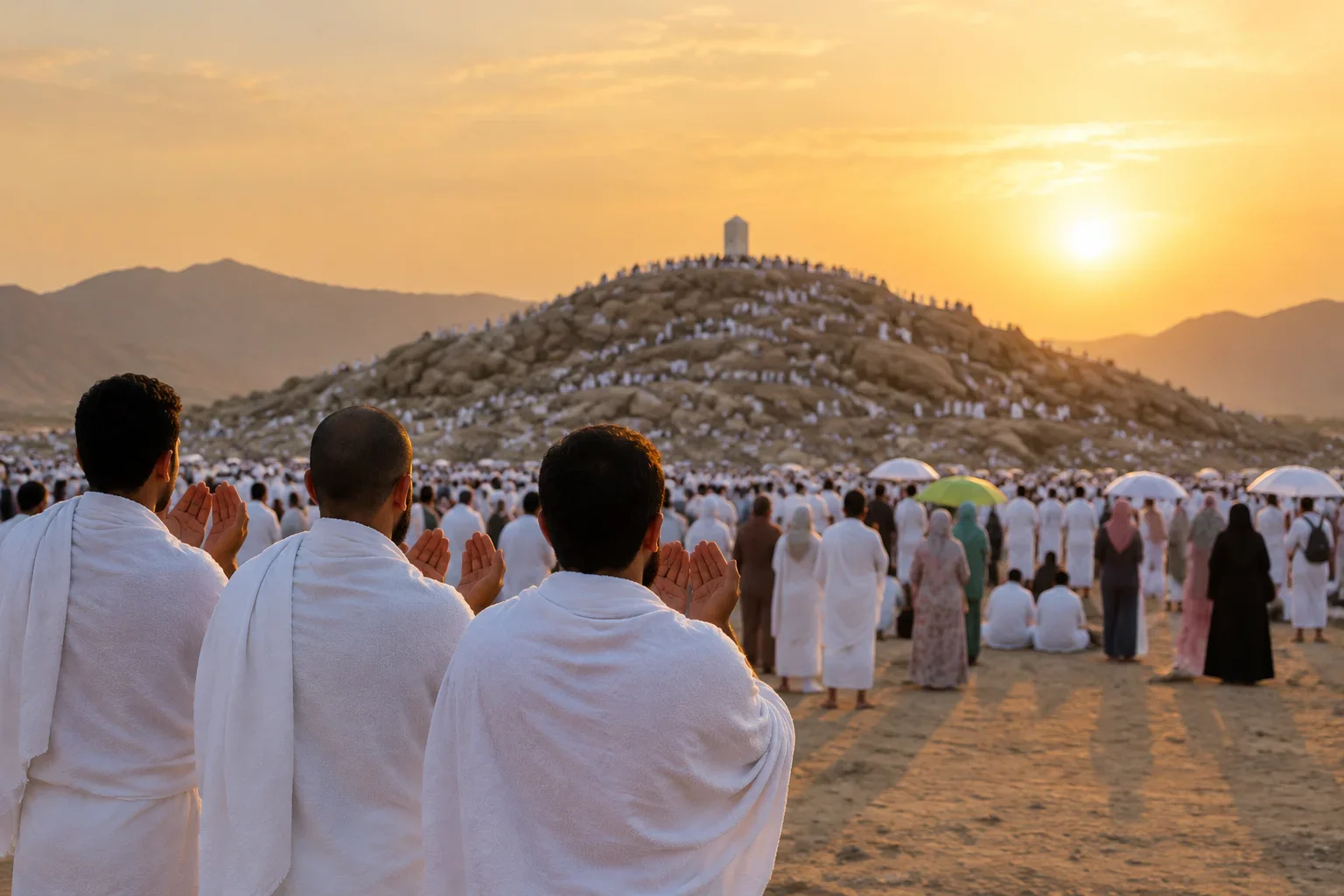
"Hajj is Arafah": a pillar of Hajj
The standing at Arafat (wuquf, being present there) is a pillar (rukn) of Hajj in the four Sunni schools. Without it there is no Hajj, and Sunni jurists report this as a consensus (Ibn al-Mundhir, Ibn Abd al-Barr, Ibn Qudama and others). The jurists cite verse 2:198 for it, and the hadith "Hajj is Arafah".
When is the standing?
The time starts at zawal on the 9th, when the sun passes its highest point, according to the Hanafi, Maliki and Shafi'i schools and one report from Ahmad. The Hanbali school starts it at dawn on the 9th (Ibn Qudama, al-Mughni 5/274). It ends at dawn on the 10th, by consensus.
The Prophet ﷺ himself began the standing after zawal and the joined prayers, and stayed until sunset (Sahih Muslim 1218a).
What counts as the standing?
Being present anywhere inside Arafat, for any moment within the time, counts, whether standing, sitting, riding or asleep. Wuquf means being present, not standing on one's feet. A moment is the minimum.
The Prophet ﷺ said: "Whoever attends this prayer of ours and stays with us until we move on, having stood at Arafah before that, by night or by day, has completed his Hajj and finished his rites" (Jami' al-Tirmidhi 891, from Urwa ibn Mudarris al-Ta'i). Al-Tirmidhi called it hasan sahih, and Darussalam graded it Sahih. In Sunan Abi Dawud (no. 1950) al-Albani graded it Sahih.
In the four Sunni schools, ritual purity, covering, facing the qibla and a specific intention are not conditions for the standing itself to count (Ibn Qudama: "we know of no disagreement on this"). A woman in her period stands at Arafat like every other pilgrim. The Prophet ﷺ told Aisha, Mother of the Believers (may Allah be pleased with her), to do what the pilgrim does, except circling the House until she is pure (Sahih al-Bukhari 305).
Sahih al-Bukhari 305Book 6, Hadith 10
We set out with the Prophet (ﷺ) for Hajj and when we reached Sarif I got my menses. When the Prophet (ﷺ) came to me, I was weeping. He asked, "Why are you weeping?" I said, "I wish if I had not performed Hajj this year." He asked, "May be that you got your menses?" I replied, "Yes." He then said, "This is the thing which Allah has ordained for all the daughters of Adam. So do what all the pilgrims do except that you do not perform the Tawaf round the Ka`ba till you are clean."
Two cases divide the schools.
- A person unconscious for the whole time: valid for the Hanafis and Malikis; not valid in the sounder Shafi'i view and for the Hanbali school (Ahmad himself paused on it).
- A passer-by who did not know he was in Arafat: valid for the Hanafis, Shafi'is and Hanbalis, and for Malik as al-Nawawi and Ibn Qudama report. The Maliki text of Khalil, as al-Jaziri explains it, requires a passer-by to know it is Arafat and to intend the standing.
Staying until sunset
The schools give three answers.
- Maliki: the pillar is being present for a moment of the night, between sunset on the 9th and dawn on the 10th. The daytime standing after zawal until sunset is obligatory, and leaving it without excuse needs a sacrifice. Whoever is there only in the day and not at all at night has missed the Hajj.
- Hanafi and Hanbali: staying until sunset is obligatory. Whoever leaves before sunset owes a sacrifice (dam).
- Shafi'i: in the sounder view, joining day and night is sunnah, so the sacrifice is recommended, not obligatory.
A pilgrim who leaves early and comes back before sunset, and stays until sunset, owes no sacrifice for the Malikis, Shafi'is and Hanbalis, and on the Hanafi view that Ibn al-Humam calls "the truth". If he comes back only after sunset, before dawn, the sacrifice falls away for the Shafi'is and Malikis. Hanbali and Hanafi scholars differ on that case.
A pilgrim who reaches Arafat only at night, between sunset on the 9th and dawn on the 10th, has a valid Hajj in the four Sunni schools. If he could not arrive in the daytime, he owes nothing. The Hanafi, Shafi'i and Hanbali schools require nothing of a pilgrim who stands only at night (Ibn Qudama, al-Mughni 5/274). The Maliki school says that someone who deliberately left out the daytime standing may stand at night and his Hajj counts, but he did wrong and owes a sacrifice (Ibn al-Qasim; Sahnun said no sacrifice).
If a pilgrim misses the standing
In the four Sunni schools, a pilgrim who is not at Arafat by dawn on the 10th has missed the Hajj. He leaves ihram (the pilgrim's sacred state) by doing the acts of an umrah, and he makes the Hajj up later. The Maliki, Shafi'i and Hanbali schools require a sacrifice; the Hanafi school does not. The basis is the rulings of Umar (may Allah be pleased with him) for Abu Ayyub (may Allah be pleased with him) and for Habbar ibn al-Aswad (may Allah be pleased with him), which are Companion rulings, not words of The Prophet ﷺ (Muwatta, Book 20, Arabic references 864 and 865).
The day step by step, from The Prophet's ﷺ Hajj
Jabir ibn Abd Allah (may Allah be pleased with them both) described The Prophet's ﷺ Hajj in a long hadith in Sahih Muslim. Read it in full in Sahih Muslim 1218a. The steps below for the Day of Arafah are our own summary of it.
- On the 8th, the Day of Tarwiya, they went to Mina. He prayed Dhuhr, Asr, Maghrib, Isha and Fajr there. Ibn Qudama says going to Mina on the 8th is recommended, not obligatory, "in the view of all of them".
- On the 9th, after Fajr, he waited a little until the sun rose, and then set out.
- A tent of hair had been pitched for him at Namirah, and he stopped there. Al-Nawawi notes that Namirah is not part of Arafat.
- After zawal, he rode to the bottom of the valley and addressed the people (see The sermon of Arafah).
- The adhan was called, then the iqamah, and he prayed Dhuhr. Then the iqamah was called and he prayed Asr, with nothing prayed between them.
- He rode to the place of standing. He turned his camel, al-Qaswa', towards the rocks, with the people on foot in front of him, and faced the qibla. He stayed standing until the sun set, the yellowness faded a little and the disc of the sun disappeared.
- He left with Usama (may Allah be pleased with them both) riding behind him. He held the camel's rein tight and gestured with his right hand: "O people, calm, calm."
- At Muzdalifah he prayed Maghrib and Isha together, with one adhan and two iqamahs.
Muslim's Arabic does not name the one who called the adhan. That he shortened his prayers as a traveller is from another hadith (Sahih al-Bukhari 1081, from Anas). Maghrib is never shortened: at Muzdalifah it is prayed as three rak'ahs, joined with Isha (Sahih Muslim 1288a; Ibn al-Mundhir reports consensus).
On the morning of Arafah, on the way from Mina to Arafat, some Companions said the talbiyah (the pilgrim's chant) and some said the takbir, and neither was objected to (Anas).
Sahih al-Bukhari 1659Book 25, Hadith 140
I asked Anas bin Malik while we were proceeding from Mina to `Arafat, "What do you use to do on this day when you were with Allah's Messenger (ﷺ) ?" Anas said, "Some of us used to recite Talbiya and nobody objected to that, and others used to recite Takbir and nobody objected to that."
The night before, at Mina. Ibn Uthaymin said the sunnah is to stay at Mina from the forenoon of the 8th until sunrise on the 9th. Going straight to Arafat is allowed, because the night at Mina is not obligatory, but it misses the better sunnah. At Mina the four-rak'ah prayers are shortened to two, each prayed in its own time; joining them is allowed for a traveller but is not the sunnah there.
Where to stand
The Prophet ﷺ said that he stood there, and that all of Arafah is a place of standing. Read it in Sahih Muslim 1218c.
Standing anywhere inside Arafat is valid, by consensus (al-Nawawi). Standing outside it does not count. Wadi Uranah is not part of Arafat, and standing there does not count for the Hanafis, Shafi'is and Hanbalis, and on the well-known Maliki view; contrary reports from Malik exist.
The hadith "move away from the bottom of Uranah" is reported from Ibn Abbas, in Sahih Ibn Khuzayma (2816) and al-Mustadrak (1697), where al-Hakim called it sahih on Muslim's condition. Al-Albani graded it Sahih (Sahih al-Jami' 903). A fuller wording from Ibn Abbas, which adds that all of Arafah is a place of standing, is in al-Tabarani; al-Albani graded it Sahih (Sahih al-Jami' 4006).
The recommended place is at the rocks at the foot of the hill in the middle of Arafat, Jabal al-Rahmah, where The Prophet ﷺ stood. Whoever cannot reach it comes as near as he can. Muslim's text says "the rocks"; it does not use the name Jabal al-Rahmah.
Markers now show the limits of Arafat, and the pilgrim must watch for them, so that his standing does not fall outside Arafat (al-Mawsu'a al-Fiqhiyya al-Kuwaytiyya 30/60). Stand inside the Arafat boundary signs.
Climbing Jabal al-Rahmah
Climbing Jabal al-Rahmah is not a rite of Hajj. Al-Nawawi called the belief that the standing is valid only on the hill "a plain error and contrary to the Sunnah", and said that "no hadith, sound or weak, came about it". Imam al-Haramayn and Ibn Taymiyya said climbing it is not a rite or a sunnah, and Ibn Uthaymin and the Saudi Permanent Committee call climbing it as worship an innovation. Al-Nawawi also reports that al-Tabari held standing on it recommended, and that al-Mawardi called it "the mount of dua".
Al-Nawawi and Ibn Taymiyya call the custom of lighting candles or fires at Arafat as part of the rite an innovation. Neither speaks of ordinary lighting for safety.
The prayers at Arafat
At Arafat, Dhuhr and Asr are joined at the time of Dhuhr, by agreement, with silent recitation even when the Day of Arafah is a Friday: The Prophet ﷺ prayed the traveller's prayer, not the Friday prayer.
Sahih al-Bukhari 1662Book 25, Hadith 143
Salim said, "In the year when Al-Hajjaj bin Yusuf attacked Ibn Az-Zubair, the former asked 'Abdullah (Ibn 'Umar) what to do during the stay on the Day of 'Arafa (9th of Dhul-Hajjah). I said to him, "If you want to follow the Sunna (the legal way of the Prophet (ﷺ)) you should offer the Salat just after midday on the Day of the 'Arafa. 'Abdullah bin 'Umar said, 'He (Salim) has spoken the truth.' " They (the Companions of the Prophet (ﷺ)) used to offer the Zuhr and Asr prayer together according to the Sunna, I asked Salim, "Did Allah's Messenger (ﷺ) do that ?" Salim said, "And in doing that do you (people) follow anything else except his (ﷺ) Sunna?"
Al-Bukhari gives this report without his own full chain.
The schools differ on details: whether the residents of Makkah shorten and join, whether someone praying alone in his tent joins, and whether there is one adhan or two.
Talbiyah and calm departure
The talbiyah continues through the Day of Arafah until the stoning of Jamrat al-Aqaba on the 10th (Sahih al-Bukhari 1543–1544). The well-known Maliki view stops it at zawal on the 9th.
Leaving Arafat after sunset, The Prophet ﷺ heard shouting and the beating of camels behind him. He pointed with his whip and urged calm.
Sahih al-Bukhari 1671Book 25, Hadith 151
I proceeded along with the Prophet (ﷺ) on the day of `Arafat (9th Dhul-Hijja). The Prophet (ﷺ) heard a great hue and cry and the beating of camels behind him. So he beckoned to the people with his lash, "O people! Be quiet. Hastening is not a sign of righteousness."
Usama (may Allah be pleased with them both) said he moved at a steady pace and went faster where he found open space (Sahih al-Bukhari 1666). On the way he stopped at a mountain pass, made a light ablution, and told Usama (may Allah be pleased with them both) that the prayer was ahead of them (Sahih al-Bukhari 1669).
Ihram still applies at Arafat
A man at the standing in Arafah fell from his mount and died. The Prophet ﷺ told them to wash and shroud him without perfume and without covering his head, as a man still in ihram. The reports do not name the man.
Sahih al-Bukhari 1849Book 28, Hadith 29
While a man was standing with the Prophet (ﷺ) at `Arafat, he fell from his Mount and his neck was crushed by it. The Prophet (ﷺ) said, "Wash the deceased with water and Sidr and shroud him in two pieces of cloth, and neither perfume him nor cover his head, for Allah will resurrect him on the Day of Resurrection and he will be reciting Talbiya."
The first release from ihram comes only after the standing, with the rites of the Day of Sacrifice. The schools differ on what brings it.
Conduct at Arafat
The verse below forbids sexual relations, disobedience and disputing during Hajj. Ibn Kathir explains disputing as arguing with a companion until he is angered.
2:197
اَلْحَجُّ اَشْهُرٌ مَّعْلُوْمٰتٌ ۚ فَمَنْ فَرَضَ فِیْهِنَّ الْحَجَّ فَلَا رَفَثَ وَلَا فُسُوْقَ ۙ وَلَا جِدَالَ فِی الْحَجِّ ؕ وَمَا تَفْعَلُوْا مِنْ خَیْرٍ یَّعْلَمْهُ اللّٰهُ ؔؕ وَتَزَوَّدُوْا فَاِنَّ خَیْرَ الزَّادِ التَّقْوٰی ؗ وَاتَّقُوْنِ یٰۤاُولِی الْاَلْبَابِ ۟
Saheeh International
Ḥajj is [during] well-known months, so whoever has made ḥajj obligatory upon himself therein [by entering the state of iḥrām], there is [to be for him] no sexual relations and no disobedience and no disputing during ḥajj. And whatever good you do - Allāh knows it. And take provisions, but indeed, the best provision is fear of Allāh. And fear Me, O you of understanding.
Al-Nawawi advises the pilgrim to avoid quarrels, insults and idle talk, not to look down on anyone, and to be gentle with the weak. Facing the qibla is recommended. On shade, al-Nawawi said it is better not to seek it unless the sun harms or weakens the person, while the Hanafi al-Quduri allows shade under a building or a litter. Riding is better in the sounder Shafi'i view and for the Hanbalis; Ibn Taymiyya said it depends on the person.
Health. Read the Saudi Ministry of Health's Hajj advice of 20 May 2026: water, an umbrella at peak hours, rest at fatigue or dizziness, regular medicines and vaccines.
The sick, the elderly and children
Being present in any state counts, so a patient can be driven or carried into Arafat. An unconscious patient's presence counts only for the Hanafis and Malikis.
Each year the Saudi Ministry of Health moves inpatient pilgrims from hospitals in Makkah and Mina to Arafat, in a medical convoy of buses and ambulances with medical staff. In 1440 AH (2019) it moved 329 inpatients, and 23 more from Madinah.
A child's Hajj is valid, and the one who takes the child is rewarded. A woman lifted up a boy and asked whether he had a Hajj; The Prophet ﷺ said yes, and that she had a reward (Sahih Muslim 1336a). It does not replace the obligatory Hajj after puberty. A report from Ibn Abbas (may Allah be pleased with them both) says a boy who performs Hajj and then reaches puberty must perform another Hajj. Al-Albani graded it sahih as The Prophet's ﷺ saying (Sahih al-Jami' 2729); al-Bayhaqi (al-Sunan al-Kubra 9849), Ibn Hajar and Ibn Abd al-Hadi held it to be the words of Ibn Abbas (may Allah be pleased with them both) himself.
If the whole community errs on the date
If the whole community, or most of it, errs and stands on the 10th, its Hajj is valid; the four schools agree. An individual or a small group who err have missed the Hajj.
The sermon of Arafah
What The Prophet ﷺ said at Arafah
Jabir (may Allah be pleased with them both) reports the sermon in Sahih Muslim 1218a (read it here). This is a summary in our own words of its seven points, in order.
- Your blood and your property are sacred to you, like the sanctity of this day of yours, in this month of yours, in this land of yours.
- Every matter of the time before Islam (the Jahiliyya) is abolished, under his feet.
- The blood claims of that time are abolished. The first he abolished was from his own family: the blood of Ibn Rabi'a ibn al-Harith, who was nursed among Banu Sa'd and killed by Hudhayl.
- The usury of that time is abolished. The first he abolished was that of al-Abbas ibn Abd al-Muttalib (may Allah be pleased with him).
- Fear Allah regarding women. You took them on Allah's trust and made them lawful by Allah's word. Your right over them is that they let no one you dislike onto your furnishings; if they do that, strike them, but not severely (ghayr mubarrih). Their right over you is provision and clothing in a fitting way.
- He said he was leaving among them something which, if they held fast to it, would keep them from going astray: the Book of Allah.
- He said they would be asked about him, and asked what they would say. They said they bore witness that he had conveyed, fulfilled and advised. He raised his index finger to the sky, pointed it at the people, and said "O Allah, bear witness" three times.
On point 5, al-Nawawi explains that a severe blow is a hard, harsh blow, so the words mean a blow that is neither hard nor harsh. He reads the condition as letting into the home someone the husband dislikes.
Where he gave it
He gave the sermon in "the bottom of the valley" (batn al-wadi), on his camel. Al-Nawawi and Ibn Taymiyya identify it as Wadi Uranah, where the front part of Masjid Namirah now stands. Muslim's text says only "the bottom of the valley". He did not give it on Jabal al-Rahmah.
"The Book of Allah", and two other wordings
In Sahih Muslim's account of the Arafah sermon, The Prophet ﷺ names "the Book of Allah". Two other wordings are reported in other books. We give both, side by side, with their grades.
"The Book of Allah and my family, the people of my house." Jami' al-Tirmidhi 3786, from Jabir, places these words in a sermon of The Prophet ﷺ on the Day of Arafah, on his camel al-Qaswa'.
- Al-Tirmidhi: "hasan gharib from this route". Darussalam: Sahih. Al-Albani: Sahih (Sahih al-Tirmidhi 3786).
- Al-Albani also said that the chain of this report is weak, and that it has a supporting report, so it is sahih through it (Hidayat al-Ruwat 6100). His sahih is for the wording, not for this chain.
- Al-Tabarani said only Zayd ibn al-Hasan al-Anmati narrated it from Ja'far, and al-Dhahabi called al-Anmati weak. The Arafah setting rests on al-Anmati's single route. Muslim's chain and al-Tirmidhi's meet only at Ja'far ibn Muhammad.
"The Book of Allah and my Sunnah." These words come from other reports, each graded on its own.
- Imam Malik, in the Muwatta, gives "the Book of Allah and the Sunna of His Prophet" without a chain (Book 46, Hadith 3, Arabic reference 1628). Ibn Abd al-Barr said it is so well known that it almost needs no chain.
- Al-Hakim (no. 318), from Ibn Abbas, says The Prophet ﷺ addressed the people in the Farewell Hajj and named "the Book of Allah and the Sunnah of His Prophet"; no day is named. Al-Hakim called the mention of the Sunnah in this sermon gharib and cited no. 319 as support. Al-Albani graded it sahih (Sahih al-Targhib 40).
- Al-Hakim (no. 319), from Abu Hurayra, has "the Book of Allah and my Sunnah", with no occasion named. Al-Albani graded it sahih (Sahih al-Jami' 2937).
- Ibn Taymiyya remarked that the words "the Book of Allah and my Sunnah" were reported in a weak hadith, without naming which report.
- Ibn Ishaq's biography, via Ibn Hisham, has "the Book of Allah and the Sunnah of His Prophet" in its sermon text, without a chain.
The Sunnah of the sermon
The sermon at Arafah is a sunnah for the imam. The Sunnah is a short sermon and an early standing. Salim ibn Abd Allah told al-Hajjaj that if he wanted to follow the Sunnah that day, he should shorten the sermon and hasten the standing, and Ibn Umar (may Allah be pleased with them both) confirmed it. Read it in Sahih al-Bukhari 1663.
The schools differ on one sermon (the Hanbalis) or two with a short sitting between them (the Hanafis, Malikis and Shafi'is). The sources also differ on the Maliki view of whether the sermon is a sunnah.
In a sermon at Arafat The Prophet ﷺ also taught what a pilgrim in ihram may wear when he cannot find a waist-wrap or sandals.
Sahih al-Bukhari 1843Book 28, Hadith 23
The Prophet (ﷺ) delivered a sermon at `Arafat and said, "Whoever does not get an Izar can wear trousers, and whoever cannot get a pair of shoes can wear Khuffs (socks made from thick fabric or leather)."
The other sermons of the Farewell Hajj
Some sermons of the Farewell Hajj are often mixed up with the Arafah sermon.
- On the Day of Sacrifice, at Mina, he spoke of the sanctity of blood, property and honour, asked whether he had conveyed the message, told those present to convey to those absent, and warned them not to turn back after him into disbelievers striking one another's necks (Sahih al-Bukhari 1739, from Ibn Abbas). He also said that many a one who is told understands better than one who heard (Bukhari 1741), and that time had come round to its form on the day Allah created the heavens and the earth, the year being twelve months, four of them sacred (Bukhari 4406).
- While stoning on the Day of Sacrifice he told the people to take their rites from him, for he did not know whether he would perform Hajj after that Hajj (Sahih Muslim 1297).
- "Satan has despaired of ever being worshipped in these lands of yours, but he will be obeyed in deeds you think small" (Jami' al-Tirmidhi 2159, from Amr ibn al-Ahwas; al-Tirmidhi: hasan sahih; Darussalam: Hasan). It was said in the Farewell Hajj, on the day the people called "the day of the greater Hajj".
- "Fear Allah your Lord, pray your five, fast your month, pay the zakat of your wealth, obey those in authority over you, and you will enter the Paradise of your Lord" (Jami' al-Tirmidhi 616, from Abu Umama; al-Tirmidhi: hasan sahih; Darussalam: Hasan). The day is not stated.
What is wrongly said about the Arafah sermon
- "No Arab has merit over a non-Arab ... except by taqwa." These words come from a sermon heard "in the middle of the days of Tashriq", not from the Arafah sermon, and they are not in Sahih Muslim (Musnad Ahmad 23489). Shu'ayb al-Arna'ut called its chain sahih, and al-Wadi'i graded it Sahih. Popular English adds "and good action" and "Adam and Eve"; the Arabic says "except by taqwa" (God-consciousness) and "your father is one".
- "No prophet will come after me and no new faith will be born." The Arabic says "there is no prophet after me and no nation after you". Abu Umama (may Allah be pleased with him) reports it, in some routes as part of a sermon of the Farewell Hajj; the reports do not say it was the Arafah sermon. Grades differ by route: al-Albani called the chain of Ibn Abi Asim's al-Sunna (1061) sahih; Ibn Adi said "al-Musayyab erred in this chain"; al-Haythami said the men of one of the two routes are trustworthy, and some have weakness.
- The long English "Farewell Sermon". It is a composite of several texts: Muslim's Arafah sermon, the Day of Sacrifice sermons in al-Bukhari, the Tashriq sermon in Musnad Ahmad, the text of Ibn Ishaq's biography as transmitted by Ibn Hisham, which gives no chain, and loose paraphrase. Ibn Ishaq's text does not include "no Arab is superior to a non-Arab", "all mankind is from Adam and Eve", or "no prophet after me".
The sermon today, and watching it live
The sermon is given at midday, once the time of Dhuhr begins. The joined and shortened Dhuhr and Asr follow it (SPA).
In 1447 AH (2026) the sermon was delivered by Sheikh Ali al-Hudhaifi (Arab News), at Masjid Namirah (Asharq Al-Awsat, 26 May 2026). The Presidency of Religious Affairs at the Grand Mosque and The Prophet's Mosque announced translation into 35 languages; the General Authority for the Care of the Grand Mosque and The Prophet's Mosque reported translation into 50 languages.
For "Arafat live": in 2025 the translated sermon was carried live on the Manarat al-Haramain platform, the Authority's YouTube page, the Tawakkalna app, and the Presidency's website and YouTube page (SPA). Channels change from year to year.
The place: the plain of Arafat and Mount Arafat
Where is Arafat?
Arafat is a plain about 20 km east of the Grand Mosque in Makkah, on the Makkah–Ta'if road. It is about 6 km from Muzdalifah and about 10 km from Mina. These are the published distances between the sites; the sources do not say how they were measured.
Of the three holy sites of the Hajj (Mina, Muzdalifah and Arafat), Arafat is the only one outside the Haram, the sacred precinct of Makkah. Namirah, on Arafat's western edge, belongs neither to Arafat nor to the Haram. Wadi Uranah, on its western side, is not part of Arafat.
Saudi official sources give two different figures for the area of Arafat: 10.4 square kilometres and about 33 square kilometres (both SPA, June 2024). Neither says how it was measured. The plain is inhabited only during the days of Hajj (SPA).
Jabal al-Rahmah ("Mount Arafat"), the Mount of Mercy
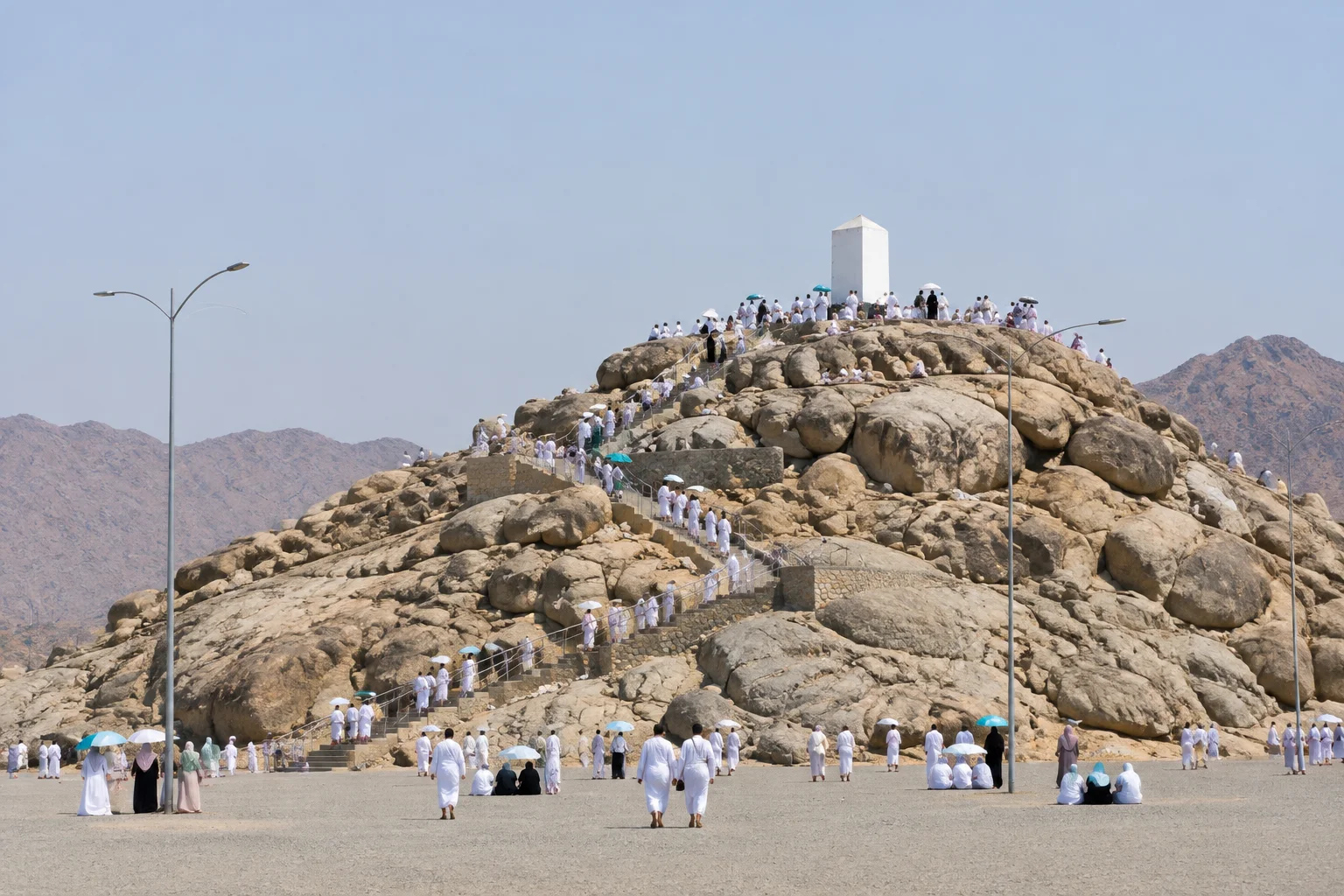
Jabal al-Rahmah is the small hill in the middle of Arafat. It rises about 65 m above the surrounding ground, and its summit is about 372 m above sea level (Saudipedia). It is about 300 m long. It is not 300 m high.
A white marker about 7 m high stands on the summit as a guide for pilgrims. In 1318 AH (1901), Ibrahim Rif'at Pasha described a square stone pillar there, about 4 m high, with lamps hung on it on the night of Arafah. Our sources do not say when today's marker was built, or whether it replaced that pillar.
Earlier, a dome with a mosque inside stood on the summit. In 579 AH Ibn Jubayr wrote that it was attributed to Umm Salama, Mother of the Believers (may Allah be pleased with her), "and the truth of that is not known". The historian al-Fasi says the dome was renewed in 799 AH with money from Sultan Barquq, after it collapsed the year before. Ibn Taymiyya said that entering the dome or praying in it is not recommended.
The name "Jabal al-Rahmah" is in use by the 5th century AH. Nasir Khusraw, on his Hajj of 442 AH (1051 CE), wrote of "a small stony hill which they call Jabal al-Rahmah", and al-Juwayni (d. 478 AH / 1085 CE) used the name too. Later authors use it, among them Ibn Jubayr, Ibn Taymiyya and Ibn Kathir. The early Makkan historians call the hill Ilal (Alal).
Some scholars dislike the name. Ibn Uthaymin said, "I know no basis for this name in the Sunnah", and preferred "Jabal Arafah" or "the hill where The Prophet ﷺ stood". Ali Badahdah also rejected the name. Saudipedia lists other names: Ilal, Jabal al-Du'a, al-Qurayn, al-Nabit, Jabal al-Tawba and Jabal Arafat. Our sources do not explain where the word "Rahmah" (mercy) in the name comes from.
Masjid Namirah
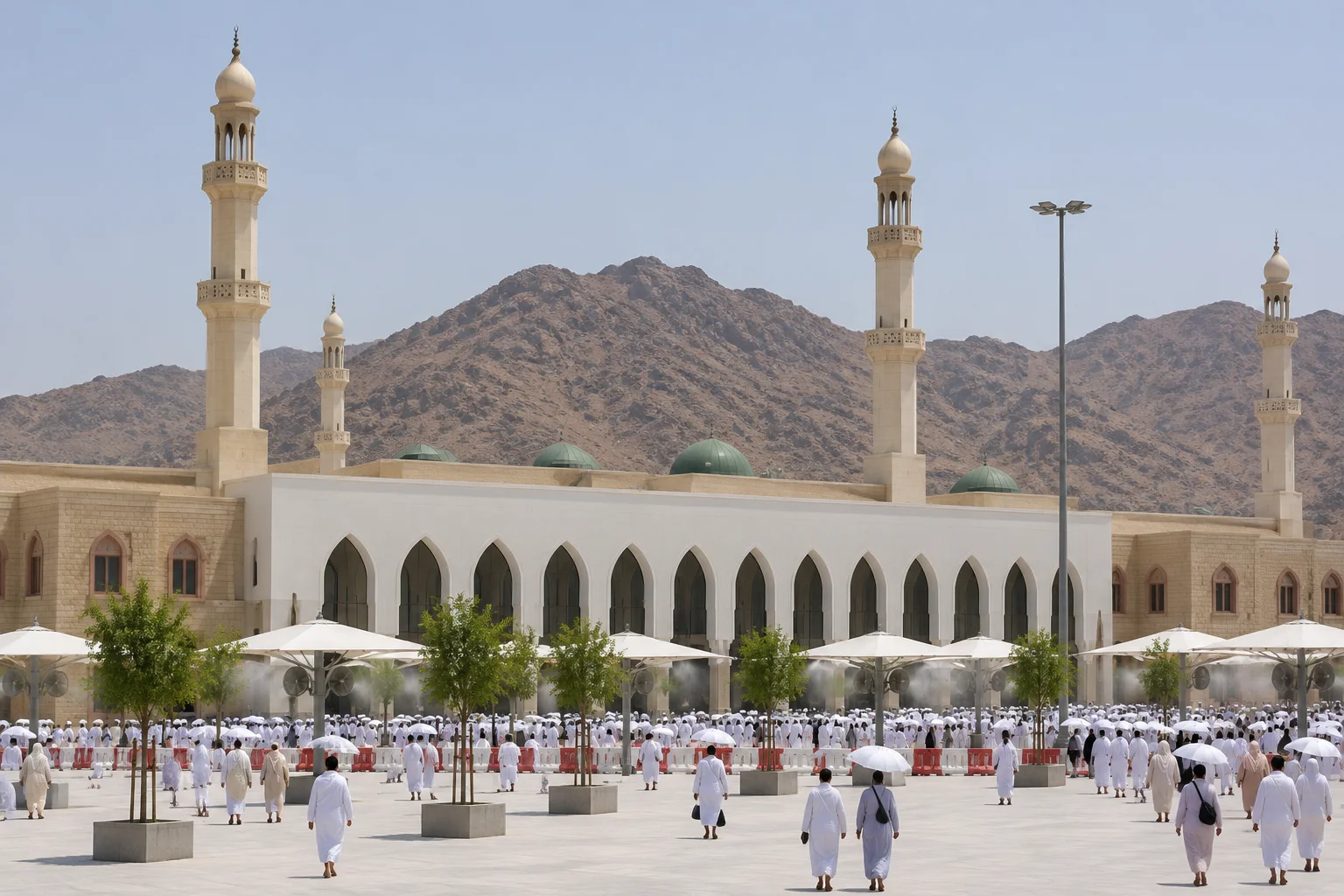
Masjid Namirah has also been called Masjid Ibrahim al-Khalil, Masjid Uranah and Masjid Arafah. It was first built about 141–150 AH, in the early Abbasid period (al-Fasi). It was renewed in 853 AH and rebuilt under Sultan Qaitbay in 874 AH (Ibn Fahd).
The Saudi state's care for the mosque began under King Abdulaziz. The present building dates from works begun in 1405 AH and an expansion in 1430 AH (General Authority for Awqaf). Its largest expansion cost about SAR 237 million.
Its area is about 110,000 square metres. It holds hundreds of thousands of worshippers; SPA has given 350,000 and 400,000. It is the second-largest mosque in the Makkah region. It opens on one day a year, the Day of Arafah, for the Dhuhr and Asr prayers, joined and shortened.
The western front part of the mosque, with the mihrab and the minbar, lies outside Arafat in Wadi Uranah; its rear part is inside Arafat (Saudipedia). The schools differ on standing in the mosque. In the Shafi'i school, standing in the front part does not count (al-Nawawi), and Ibn Baz said the area east of the mosque is Arafah. In the Maliki school, Khalil says standing in "its mosque" counts, though it is disliked; al-Hattab lists five Maliki views. Stand inside the Arafat boundary signs.
Arafat today
- The Mashaer railway has linked Arafat, Muzdalifah and Mina since November 2010. Its operating figures differ between sources.
- Neem trees were planted from 1986 as a waqf (endowment) project of the Saudi businessman Abdul Rahman Fakieh, reaching 300,000 trees by 2011 (Arab News). The same report says the Permanent Committee for Ifta issued a ruling against cutting trees in the holy sites.
- Cooling and shade projects surround Jabal al-Rahmah: 196,000 square metres in 2025, including 1,200 square metres of canopies with 129 misting fans (SPA), and more than 392,000 square metres in 2026 (Kidana). Kidana's 2026 report also says more than 60,000 trees were planted under its Green Holy Sites initiative, and more than 6,900 toilets were added across Muzdalifah and Arafat.
- Ayn Zubaydah, the water channel named after Zubaydah bint Ja'far, wife of the Abbasid caliph Harun al-Rashid, brought water from Wadi Nu'man towards Makkah and Arafat. Its start date and length differ between official sources.
How many pilgrims?
The Saudi General Authority for Statistics (GASTAT) counts the total number of Hajj pilgrims, not the number of people present at Arafat.
| Hajj season | Pilgrims who performed Hajj | Source |
|---|---|---|
| 1447 AH (2026) | 1,707,301; external pilgrims from 165 nationalities | GASTAT |
| 1446 AH (2025) | 1,673,230 | GASTAT |
History of the day
Ibrahim
Ibrahim and Ismail raised the foundations of the House and asked Allah to show them their rites. Allah commanded Ibrahim to proclaim the Hajj to the people.
2:127
وَاِذْ یَرْفَعُ اِبْرٰهٖمُ الْقَوَاعِدَ مِنَ الْبَیْتِ وَاِسْمٰعِیْلُ ؕ رَبَّنَا تَقَبَّلْ مِنَّا ؕ اِنَّكَ اَنْتَ السَّمِیْعُ الْعَلِیْمُ ۟
Saheeh International
And [mention] when Abraham was raising the foundations of the House and [with him] Ishmael, [saying], "Our Lord, accept [this] from us. Indeed, You are the Hearing, the Knowing.
2:128
رَبَّنَا وَاجْعَلْنَا مُسْلِمَیْنِ لَكَ وَمِنْ ذُرِّیَّتِنَاۤ اُمَّةً مُّسْلِمَةً لَّكَ ۪ وَاَرِنَا مَنَاسِكَنَا وَتُبْ عَلَیْنَا ۚ اِنَّكَ اَنْتَ التَّوَّابُ الرَّحِیْمُ ۟
Saheeh International
Our Lord, and make us Muslims [in submission] to You and from our descendants a Muslim nation [in submission] to You. And show us our rites [of worship] and accept our repentance. Indeed, You are the Accepting of Repentance, the Merciful.
22:27
وَاَذِّنْ فِی النَّاسِ بِالْحَجِّ یَاْتُوْكَ رِجَالًا وَّعَلٰی كُلِّ ضَامِرٍ یَّاْتِیْنَ مِنْ كُلِّ فَجٍّ عَمِیْقٍ ۟ۙ
Saheeh International
And proclaim to the people the ḥajj [pilgrimage]; they will come to you on foot and on every lean camel; they will come from every distant pass -
The Prophet ﷺ linked the standing at Arafah to Ibrahim. His messenger Ibn Mirba' al-Ansari (may Allah be pleased with him) came to people standing far from the imam at Arafah and said: "I am the messenger of the Messenger of Allah ﷺ to you. He says: Stay at your places of ritual, for you are upon an inheritance from the inheritance of your father Ibrahim" (Sunan Abi Dawud 1919, al-Albani: Sahih; Jami' al-Tirmidhi 883, Darussalam: Sahih).
The detailed stories of Jibril guiding Ibrahim at Arafat are the Companion and Successor reports given under What "Arafah" means, not sayings of The Prophet ﷺ.
Before Islam
Before Islam, the Quraysh (the Hums) stood at Muzdalifah while the other Arabs stood at Arafat (Sahih al-Bukhari 1665; Sahih Muslim 1219a). In the account of Jabir (may Allah be pleased with them both) of the Farewell Hajj, the Quraysh did not doubt that The Prophet ﷺ would stop at al-Mash'ar al-Haram as they used to, but he went on to Arafat.
Ibn Abbas (may Allah be pleased with them both) said the Arabs before Islam left Arafat before sunset, "when the sun was on the mountain tops like turbans on men's heads", and that The Prophet ﷺ delayed the departure until after sunset (Ibn Abi Hatim, quoted by Ibn Kathir, who called a fuller version's chain hasan). Ibn Khuzayma disclaimed one of its narrators, Zam'a ibn Salih (Sahih Ibn Khuzayma 2838). That The Prophet ﷺ stayed until sunset is firmly established in Sahih Muslim 1218a.
The Prophet ﷺ stood at Arafat before the Hijra. Jubayr ibn Mut'im (may Allah be pleased with him), searching for his lost camel on the day of Arafah, saw him standing at Arafat and wondered why a man of the Hums was there. Ibn Hajar says this was before the Hijra, before Jubayr became Muslim.
Sahih al-Bukhari 1664Book 25, Hadith 145
My father said, "(Before Islam) I was looking for my camel .." The same narration is told by a different sub-narrator. Jubair bin Mut`im said, "My camel was lost and I went out in search of it on the day of `Arafat, and I saw the Prophet (ﷺ) standing in `Arafat. I said to myself: By Allah he is from the Hums (literally: strictly religious, Quraish were called so, as they used to say, 'We are the people of Allah we shall not go out of the sanctuary). What has brought him here?"
The Farewell Hajj
The Farewell Hajj took place in the 10th year after the Hijra. Jabir (may Allah be pleased with them both) said The Prophet ﷺ stayed nine years without performing Hajj, then announced to the people in the tenth year that he would perform it (Sahih Muslim 1218a).
The Day of Arafah of the Farewell Hajj was a Friday, according to Umar's report in al-Bukhari and Muslim. It fell in March 632 CE. On that day verse 5:3 came down, as Umar (may Allah be pleased with him) reported (see Arafah in the Quran).
Recorded moments
- 579 AH. The traveller Ibn Jubayr saw the standing at Arafat on a Friday. Non-Arab pilgrims from Khurasan and others from Iraq lit Jabal al-Rahmah and its mosque with candles. Older residents said they had never seen a larger crowd at Arafat, and Ibn Jubayr thought there had been none like it since Harun al-Rashid, "the last of the caliphs to perform Hajj". That year a preacher in Makkah told people that a Friday standing equals seventy standings; scholars reject this claim.
- Hakim ibn Hizam (may Allah be pleased with him). Historians report that Hakim ibn Hizam (may Allah be pleased with him) stood 100 slaves at Arafah on the Day of Arafah, with silver collars engraved "Freed for Allah on behalf of Hakim ibn Hizam", and freed them (al-Zubayr ibn Bakkar). It is a historical report; no hadith critic's grade was found.
- Sufyan ibn Uyayna. Sufyan ibn Uyayna attended about seventy Hajj seasons; one report says eighty (Tarikh Baghdad; Siyar A'lam al-Nubala').
- 2010. The Mashaer railway opened, linking Arafat, Muzdalifah and Mina.
- 2015. The crush of 24 September 2015 happened in Mina, the day after Arafah, not at Arafat.
- 2020. Hajj 1441 AH was limited to 1,000 pilgrims from within Saudi Arabia because of COVID-19 (Saudipedia, citing GASTAT).
Common claims to be careful with
These claims are repeated widely. Each line says what the named scholars found.
Fasting
- "Fasting Arafah wipes out all sins, including major sins." The hadith says the fast expiates the year before and the year after. It does not say "all sins". See Which sins are expiated?.
- "Fasting the 8th expiates a year, and Arafah two years." Weak (al-Albani, Irwa' 956); with the Arafah addition, fabricated (al-Albani). The 8th is recommended as one of the ten days, not for this reward. The authentic Arafah reward is in Sahih Muslim 1162.
- "Each day of the ten equals a year of fasting, and each night equals Laylat al-Qadr" (Jami' al-Tirmidhi 758). Al-Tirmidhi called it gharib; al-Albani graded it weak; Ibn al-Jawzi said it is not authentic.
- "Fasting Arafah equals a thousand days." Weak or munkar (al-Albani); munkar (al-Dhahabi).
- "Fasting the Day of Arafah expiates the year before it", from Aisha (Musnad Ahmad 24970). Weak (al-Albani, Da'if al-Targhib 609). Use Abu Qatada's report in Sahih Muslim.
- "The Arafah fast must be paired with the 8th." It is not required (Ibn Baz).
- "Say this intention dua for the Arafah fast." No wording from The Prophet ﷺ for this intention was found. The intention is in the heart.
- "The Prophet ﷺ fasted the Day of Arafah", or "the only time he did not fast it was his Hajj". Neither can be stated as settled fact. At the Farewell Hajj he did not fast at Arafah (Sahih al-Bukhari 1988). One disputed report says he "used to fast nine days of Dhul Hijjah" (Abu Dawud 2437: sahih per al-Albani; weak per Shu'ayb al-Arna'ut and al-Zayla'i). No report in Ibn Majah says it was the only time.
- "'Arafah ... days of eating and drinking' forbids people at home to fast." Al-Nasa'i placed this hadith in his Book of Hajj, in the chapter on the prohibition of fasting the Day of Arafah (Sunan al-Nasa'i 3004), so he read it as being about pilgrims.
Dua, dhikr and special prayers
- "Pray four rak'as on Arafah between Dhuhr and Asr, reciting al-Ikhlas 50 times." Fabricated (Ibn al-Jawzi; al-Shawkani).
- "Say the tahlil, al-Ikhlas and blessings on The Prophet ﷺ 100 times each on the evening of Arafah, and Allah forgives everyone." Weak (al-Albani, al-Silsila al-Da'ifa 5104; Ibn Hajar: weak chain). The report speaks of a pilgrim at the standing.
- "Recite al-Ikhlas 1,000 times on the evening of Arafah." Listed in a book of fabricated reports (Ibn 'Arraq, after al-Suyuti), with narrators of unknown standing. Do not use it.
- "Recite this surah on the Day of Arafah." No authentic Sunni report prescribing a surah for the day was found.
- "Whoever says these ten phrases 1,000 times on the night of Arafah gets whatever he asks." Munkar (al-Albani, al-Silsila al-Da'ifa 5982); not authentic (Ibn al-Jawzi).
- "Whoever revives the night of Arafah will enter Paradise." Fabricated (al-Albani); not authentic (Ibn al-Jawzi). Night prayer itself is recommended in the ten nights (Hanbali and Hanafi scholars).
- "Whoever guards his tongue, hearing and sight on Arafah is forgiven from Arafah to Arafah." Weak (al-Albani; al-Suyuti).
- "On the Day of Arafah there is an hour in which every dua is answered." That hour belongs to Friday. It meets the Day of Arafah only when the day is a Friday.
- "The best dua hadith is in Sahih Muslim." It is Jami' al-Tirmidhi 3585 (and a mursal report in the Muwatta).
- "The Prophet's ﷺ most frequent Arafah dua was Allāhumma laka al-ḥamdu ka-lladhī taqūlu ..." (Jami' al-Tirmidhi 3520). Al-Tirmidhi: gharib, its chain is not strong; Darussalam: Da'if.
- "Ali's Arafah dua, Allāhumma ij'al fī qalbī nūran ..." Weak (al-Bayhaqi; Shu'ayb al-Arna'ut: broken chain).
- The long dua "O Allah, You hear my speech and see my place ...", given as The Prophet's ﷺ Arafah dua. A dua reported by al-Tabarani from Ibn Abbas, from the Farewell Hajj, with a weak chain (al-Haythami, al-Iraqi, al-Albani).
- "The Prophet ﷺ spent six hours in continuous dua." No report counts hours. After the joined prayers he stood facing the qibla until sunset (Sahih Muslim 1218a), and he raised his hands in dua there (Sunan al-Nasa'i 3011, Darussalam: Hasan).
- "A special dua replaces Hajj or umrah for a woman in her period." No authentic source (islamqa.info 65575).
Virtues of the day
- "When Arafah falls on a Friday it equals 70 (or 72) Hajj." False, with no basis: al-Albani; Ibn al-Qayyim called it "false and there is no basis for it"; Ibn Uthaymin agreed. The next Friday Arafah is expected on 12 April 2030.
- "Allah descends to the lowest heaven on Arafah." Sahih Muslim 1348 says He "draws near", and this page builds on that wording. Reports that say "descends" exist: Jabir's report in Sahih Ibn Hibban 3853 (sahih per Shu'ayb al-Arna'ut; weak per al-Albani) and al-Bazzar's report from Ibn Umar (hasan li-ghayrihi per al-Albani).
- "Allah descends to Arafah on that night and does not go back up." This narrative (from Abu Umama) is fabricated per Ibn al-Jawzi and al-Albani. That grade covers this narrative only, not Sahih Muslim 1348.
- "Allah boasts to the angels at the time of Isha on the Day of Arafah." The Arabic word is 'ashiyya, which al-Azhari defines as from the sun's decline to sunset.
- "The Day of Arafah is the best day of the year", stated as settled. Scholars differ. See Is it the best day of the year?.
- "No day on which Allah frees more from the Fire" cited as "Tirmidhi". It is Sahih Muslim 1348.
- "Some sins are expiated only by the standing at Arafah." As a saying of The Prophet ﷺ, al-Iraqi said "I found no basis for it", and Ibn al-Subki found no chain for it.
- "Allah writes the life-spans and provisions in four nights, including the night of Arafah." Not authentic (al-Daraqutni).
The sacrifice, the bath and Ibrahim
- "The Prophet ﷺ bathed on the Day of Arafah" (Sunan Ibn Majah 1316). Fabricated (Darussalam; al-Albani).
- "An extra Qurbani on the Day of Arafah brings a double reward." No such report was found. An udhiyah slaughtered before the Eid prayer does not count as the rite, so it cannot be slaughtered on the Day of Arafah.
- "Qurbani is wajib", stated as a rule for everyone. The schools differ. See Is the Eid sacrifice obligatory?.
- "Ibrahim prepared to sacrifice his son at Mount Arafat." Classical commentators place the sacrifice at Mina or elsewhere in Makkah, and none places it at Arafat.
- "Adam and Hawwa met at Arafat", stated as fact. It is al-Dahhak's statement, quoted without a chain.
- "The name comes from a hadith in which Jibril asked Ibrahim 'Do you know?'" These are reports of Companions and Successors, not a hadith of The Prophet ﷺ.
- "People will be gathered at Arafat on the Day of Resurrection." No authentic report says people will be gathered at Arafat (islamqa.info, answer 11954).
The Quran
- "The day of the greater Hajj is the Day of Arafah", stated as the only view. The authentic reports from The Prophet ﷺ name the Day of Sacrifice; a group of early scholars said the Day of Arafah.
- "The covenant of 7:172 was taken on the Day of Arafah." The wording we cite names the place, Na'man, "meaning Arafah", not the day, and the report's attribution is disputed. We do not state the day as settled fact.
Pilgrims and the place
- "The standing must be on Jabal al-Rahmah", or "climbing it is a rite". Al-Nawawi called this "a plain error". All of Arafah is a place of standing.
- "Wuquf means standing on your feet." It means being present.
- "A woman in her period cannot do the standing." She can.
- "Leaving Arafat before sunset invalidates the Hajj", stated for everyone. Only the Maliki school treats a moment of the night as the pillar; the other schools hold the Hajj valid, with a sacrifice due or recommended.
- "The standing starts at zawal, by consensus." The Hanbali school starts it at dawn.
- "Maghrib is shortened to three rak'ahs." Maghrib is never shortened; it is three rak'ahs, joined with Isha at Muzdalifah.
- "The Prophet ﷺ gave the Farewell Sermon on Jabal al-Rahmah." He gave it in the bottom of the valley, on his camel, before the prayers.
- "All of Masjid Namirah is inside Arafat." Its western front part is in Wadi Uranah.
- "Masjid Namirah holds only one prayer a year." It opens on one day a year for two prayers, Dhuhr and Asr, joined and shortened.
- "Jabal al-Rahmah is 300 m high." It rises about 65 m above the plain; 300 m is its length.
- "Millions of pilgrims at Arafat", using GASTAT totals. GASTAT counts the pilgrims who performed Hajj, not the people at Arafat.
- "King Abdulaziz built the present Masjid Namirah." The present building dates from works begun in 1405 AH and an expansion in 1430 AH (Awqaf).
- "The neem trees of Arafat were a gift from a king or a president." We found no official source for the gift stories. The documented account is the waqf planting begun in 1986 by Abdul Rahman Fakieh.
- "The 2015 Hajj disaster happened at Arafat." It happened in Mina, on the day after Arafah.
- "The Day of Arafah falls 10 days earlier each year." It falls about 11 days earlier on average; the shift is 10, 11 or 12 days.
The sermon
- "'I leave you the Quran and my Sunnah' was said at Arafah, in Sahih Muslim." Muslim's Arafah text says "the Book of Allah". The other wordings and their grades are under The sermon of Arafah.
- "No Arab is superior to a non-Arab" in the Arafah sermon, or in Sahih Muslim. It is from a sermon in the days of Tashriq, in Musnad Ahmad.
- "No prophet will come after me and no new faith will be born." "No new faith will be born" is not the wording.
Takbir
- "The takbir is wajib for both men and women." This is the view of Abu Yusuf and Muhammad, the Hanafi fatwa view; the other schools hold it recommended.
- "Everyone recites the takbir out loud." Men say it aloud; women say it in a lower voice, worded differently by each school.
- "The Prophet ﷺ said the takbir from Fajr of Arafah to Asr of the 13th." No authentic report from The Prophet ﷺ fixes the timing; the timings come from the Companions' practice and the schools.
Questions people ask
What is the Day of Arafah?
It is the 9th day of Dhul Hijjah, the day before Eid al-Adha, when the pilgrims stand on the plain of Arafat.
What day is Arafah in 2027?
It is expected on Saturday 15 May 2027 in Saudi Arabia's Umm al-Qura calendar. The Saudi Supreme Court fixes the actual day after the crescent is sighted, and your country may keep it a day later.
Is the Day of Arafah mentioned in the Quran?
The place, Arafat, is named once, in 2:198. The word "Arafah" does not occur in the Quran. Umar (may Allah be pleased with him) reported that verse 5:3 came down on the Day of Arafah.
Is fasting on the Day of Arafah obligatory?
No. For people who are not on Hajj it is a recommended sunnah, by agreement of the four Sunni schools.
What does fasting the Day of Arafah expiate? Does it expiate major sins?
The Prophet ﷺ hoped from Allah that it expiates the year before it and the year after it. Al-Nawawi reports that the scholars explain this as minor sins; some scholars held that major sins are included.
Should I fast with Saudi Arabia or with my own country?
Scholars differ. Ibn Uthaymin and islamqa.info say fast your own country's 9th; the Saudi Permanent Committee says the Day of Arafah is the day the pilgrims stand. Follow the Muslim authority or community where you live.
Can I fast the Day of Arafah on a Saturday?
The four schools allow it, even on its own. Al-Albani held that a voluntary fast, Arafah included, is not kept on a Saturday.
When does the Arafah fast start and end?
From true dawn (Fajr) to sunset (Maghrib) where you are. Check your town on our prayer times pages.
Can I fast Arafah if I owe Ramadan days?
Views differ. Ibn Uthaymin allows fasting it with a make-up intention and hopes for both rewards; some scholars forbid voluntary fasts before the make-up.
What can a woman in her period do on the Day of Arafah?
She does not fast, but she can make dua and dhikr freely and say the takbir.
What is the best dua for the Day of Arafah?
The Prophet ﷺ named the tahlil: Lā ilāha illā Allāh, waḥdahu lā sharīka lah, lahu al-mulku wa lahu al-ḥamd, wa huwa ʿalā kulli shayʾin qadīr (Jami' al-Tirmidhi 3585, graded hasan by al-Albani and Shu'ayb al-Arna'ut through supporting reports; weak in its own chain per Ibn Hajar and Darussalam).
Is there a best time for dua at home?
Make dua throughout the day. We found no text that names a best time for people at home; The Prophet ﷺ made dua at Arafat in the afternoon until sunset.
What is the difference between the Day of Arafah and Ashura?
In the same hadith, fasting Arafah is hoped to expiate two years and fasting Ashura one year. The hadith gives no reason for the difference.
When does Takbir al-Tashreeq start and end?
No authentic hadith of The Prophet ﷺ fixes it. The schools' views are from Fajr of the 9th to Asr of the 13th, from Fajr of the 9th to Asr of the 10th, or from Zuhr of the 10th to Fajr of the 13th; see the table in the takbir section.
What should I do on the Day of Arafah at home?
Fast, make much dua, say the tahlil and the takbir, and do good deeds. If you will sacrifice, leave your hair and nails.
Can I cut my hair or nails before Eid?
If you will offer the Eid sacrifice, the hadith tells you to leave them until you have sacrificed. Scholars differ on whether this is forbidden, disliked or not disliked.
Do pilgrims fast on the Day of Arafah?
The Prophet ﷺ did not fast at Arafat. The Maliki, Shafi'i and Hanbali schools dislike the fast for the pilgrim, according to the Dorar encyclopedia; the Hanafis recommend it if it does not weaken him.
Is Mount Arafat the same as the plain of Arafat?
No. "Mount Arafat" is a popular name for Jabal al-Rahmah, the small hill in the middle of the plain. The standing is valid anywhere inside Arafat.
Is the Day of Arafah a public holiday?
In Saudi Arabia, yes: it falls inside the Eid al-Adha holiday.
How we label sources, and the sources
About the hadith collections. Sunni hadith scholars accept the chained reports of Sahih al-Bukhari and Sahih Muslim as authentic; al-Bukhari's unchained reports and chapter notes are outside that judgment. The English is a translation. Hadith numbers follow sunnah.com. For Sahih Muslim this is Muhammad Fu'ad Abd al-Baqi's number with sunnah.com's letter (for example 1162a). For Sunan Abi Dawud, Jami' al-Tirmidhi, Sunan al-Nasa'i and Sunan Ibn Majah we use sunnah.com's numbers; the grade line on sunnah.com is al-Albani's for Abu Dawud and Darussalam's for the other three. Musnad Ahmad numbers are those dorar.net uses (Shu'ayb al-Arna'ut's numbering). For the Muwatta of Malik we give sunnah.com's Arabic reference number.
About the dua card. The tahlil card comes from our Hisn al-Muslim collection (dua 93). Its Arabic was checked against the printed 1436 AH edition of the book. Its English and transliteration come from sunnah.com and were not checked against the publisher's English edition.
Sources
Quran
- The Quran, Hafs numbering, from our frozen Quran text with the Saheeh International translation: 2:127–128, 2:197, 2:198, 2:199, 2:203, 3:8, 3:193–194, 5:3, 7:172, 14:40–41, 22:27, 22:28, 85:3, 89:2–3. Also cited: 9:3, 9:36.
Hadith in Sahih al-Bukhari and Sahih Muslim (sunnah.com numbering)
- Sahih al-Bukhari: 45, 304, 305, 969, 970, 971, 1081, 1543–1544, 1658, 1659, 1662, 1663, 1664, 1665, 1666, 1669, 1671, 1739, 1741, 1843, 1849, 1907, 1923, 1960, 1988, 1989, 1997, 1998, 2697, 3293, 4406, 4407, 4520, 4606, 5192, 5545, 5560, 6340, 6389, 6403, 6502, 7268.
- Sahih Muslim: 853, 1015, 1095, 1123a, 1124, 1141a, 1144b, 1154b, 1162a, 1162b, 1176a, 1218a, 1218c, 1219a, 1288a, 1297, 1336a, 1348, 1977c, 2691, 2732a, 2735, 2735c, 3017, 3017c.
Other hadith collections (with the graders named in the text)
- Jami' al-Tirmidhi 616, 744, 749, 751, 757, 758, 773, 883, 889, 890, 891, 957, 958, 2159, 3044, 3088, 3339, 3520, 3585, 3786: https://sunnah.com/tirmidhi
- Sunan Abi Dawud 1048, 1765, 1919, 1945, 1949, 1950, 2419, 2421, 2437, 2438, 2440: https://sunnah.com/abudawud
- Sunan al-Nasa'i 3004, 3011, 3016; Sunan Ibn Majah 1316, 1727, 1730, 1732, 3014, 3015: https://sunnah.com/nasai, https://sunnah.com/ibnmajah
- Muwatta Malik, Book 20 (Arabic references 837, 864, 865, 950, 951) and Book 46 (Arabic reference 1628): https://sunnah.com/malik/20, https://sunnah.com/malik/46
- Musnad Ahmad 2707, 6961, 7089, 8047, 14511, 23489, 24970; Sahih Ibn Khuzayma 2816, 2838, 2839; Sahih Ibn Hibban 3852, 3853; al-Mustadrak of al-Hakim 318, 319, 1697; al-Bazzar; al-Tabarani, al-Mu'jam al-Awsat; Ibn Abi Shaybah 5679 ('Awwama numbering); Ibn Abi Asim, al-Sunna 1061; al-Bayhaqi, al-Sunan al-Kubra 9849. Grades as shown by dorar.net: https://dorar.net/hadith
Tafsir
- Al-Tabari, Ibn Kathir and al-Qurtubi on 2:198, 2:199, 2:203, 5:3, 7:172, 9:3, 9:36, 22:28, 37:102–107, 85:3, 89:2–3: https://quran.ksu.edu.sa/tafseer/ and https://api.quran.com
Fiqh and fatwas
- Al-Mawsu'a al-Fiqhiyya (Dorar), pages 1771, 1775, 2629, 2644, 2773, 2778, 2780, 2782, 2793, 3024, 3026, 3028, 3030, 3074, 3106: https://dorar.net/feqhia/
- Saudi Permanent Committee, fatwa 4052, Fatawa al-Lajna al-Da'ima (first collection) 10/393–394: https://shamela.ws/book/8381/7607
- Ibn Uthaymin, Majmu' Fatawa wa Rasa'il 19/39–43, 20/47–48: https://shamela.ws/book/12293/7314 (volume 19), https://shamela.ws/book/12293/7699
- Ibn Baz, Majmu' Fatawa 15/405: https://shamela.ws/book/21537/8177; fatwa 9005: https://binbaz.org.sa/fatwas/9005/; audio answer 2697 on binbaz.org.sa
- Egypt's Dar al-Ifta, fatwas 231, 1720, 3575, 3820, 3951, 6081, 7547, 7937, 8969, 8984: https://www.dar-alifta.org
- islamqa.info answers 11954, 20953, 34154, 36627, 40720, 41901, 65575, 70282, 81621, 128256, 140011, 414410: https://islamqa.info
- OIC International Islamic Fiqh Academy, Resolution 18 (1986): https://iifa-aifi.org/ar/1669.html
- Fiqh Council of North America, Eid announcements 2021–2026 (archived copies).
- Al-Nawawi, al-Majmu' and Sharh Sahih Muslim; Ibn Qudama, al-Mughni; Ibn Abd al-Barr, al-Tamhid; Ibn Taymiyya, Majmu' al-Fatawa, Iqtida' al-Sirat al-Mustaqim and Bayan Talbis al-Jahmiyya; Ibn al-Qayyim, Zad al-Ma'ad; Ibn Hajar, Fath al-Bari; Ibn Rajab, Lata'if al-Ma'arif; Ibn Abidin, Radd al-Muhtar; al-Hattab, Mawahib al-Jalil; al-Mawsu'a al-Fiqhiyya al-Kuwaytiyya; Ali Badahdah, on the name Jabal al-Rahmah.
Dates and the calendar
- Umm al-Qura calendar (KACST): https://www.ummulqura.org.sa/en/about-calendar
- Saudi Supreme Court statements via the Saudi Press Agency: https://www.spa.gov.sa/en/N2587986, https://www.spa.gov.sa/en/N2327792, https://www.spa.gov.sa/en/N2118090, https://www.spa.gov.sa/en/N2324770
- Saudi Ministry of Human Resources and Social Development, article 322: https://www.hrsd.gov.sa/en/knowledge-centre/articles/322
The place, the sermon today and pilgrim numbers
- Saudi Press Agency, Saudipedia, the General Authority for Awqaf, the Saudi General Authority for Statistics (Hajj reports 1446 and 1447), the Saudi Ministry of Health, Arab News, Asharq Al-Awsat, Riyadh Daily and Kidana. GASTAT 1447: https://www.stats.gov.sa/documents/d/guest/hajj-report-1447h-en ; Ministry of Health advice, 20 May 2026: https://www.moh.gov.sa/en/ministry/mediacenter/news/pages/news-2026-05-20-003.aspx
History
- Ibn Jubayr, Rihla; Nasir Khusraw, Safarnama; al-Juwayni, Nihayat al-Matlab; al-Fasi, Shifa' al-Gharam; Ibn Fahd, Ithaf al-Wara; Ibrahim Rif'at Pasha, Mir'at al-Haramayn; Ibn Hisham, al-Sira; al-Zubayr ibn Bakkar, Jamharat Nasab Quraysh; Tarikh Baghdad; Siyar A'lam al-Nubala'.